
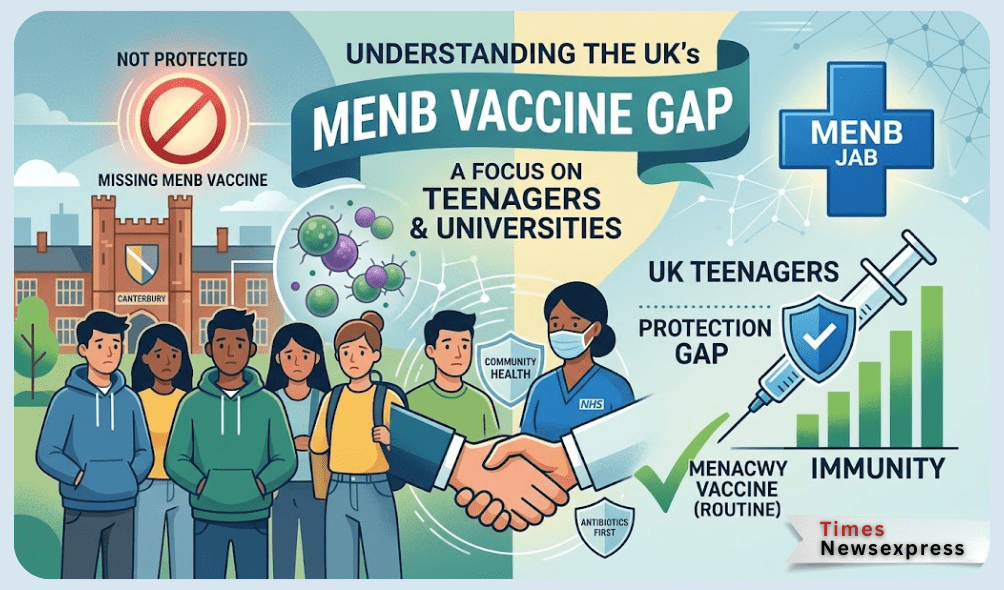
The UK Health Security Agency (UKHSA) has recently confirmed a rise in meningitis cases across Kent, with 18 confirmed illnesses and another 11 suspected cases. This surge, centred around Canterbury, has tragically resulted in the deaths of two young people and triggered an urgent expansion of local vaccination and antibiotic programmes.
As the outbreak evolves, many parents and students are asking a critical question: Why is the Meningitis B (MenB) vaccine routine for babies but not for the teenagers currently at the highest risk?
Table of Contents
The Kent Outbreak – A Targeted Response in Canterbury
The epicentre of the current health crisis has been linked to social hotspots in Canterbury, specifically Club Chemistry. Anyone who visited the venue after March 5th has been urged to seek medical intervention.
In response, health officials have moved beyond the initial “close contact” circle. The vaccination campaign now includes:
- Students at the University of Kent and Canterbury Christ Church University.
- Sixth-form students at four local schools with suspected cases.
- Individuals previously identified for precautionary antibiotics.
While the response is aggressive, it highlights a massive gap in the UK’s national immunisation strategy that has left an entire generation of young adults vulnerable.
Why Are Teenagers Missing the MenB Vaccine?
The MenB vaccine was introduced to the NHS routine schedule in 2015 but it was specifically targeted at infants. Because there was no widespread “catch-up” campaign at the time, most of today’s university students and older teenagers have never received it.
Currently, UK teenagers are routinely offered the MenACWY vaccine around age 14. While this provides excellent protection against four strains of the disease, it offers zero protection against the B strain, which is currently driving the Kent outbreak.
The Complexity of Teen Vaccination
Public health advisors, specifically the Joint Committee on Vaccination and Immunisation (JCVI), have historically argued against routine MenB jabs for teens for several scientific and economic reasons:
- Immediate vs. Long-term Protection: Vaccines take several weeks to build an immune response and often require multiple doses. In an active outbreak, antibiotics remain the first line of defence because they eliminate bacteria in the throat instantly.
- Transmission Dynamics: While the MenB vaccine protects the individual, it is less effective than the MenACWY jab at stopping ‘carriage’ – the act of carrying and spreading the bacteria to others.
- Waning Immunity: Protection from the MenB vaccine is not permanent. Experts suggest that if administered too early, the protection might fade by the time a student enters the high-density environment of university life.
- Cost-Effectiveness: Until recently, the JCVI deemed a mass rollout for teenagers as not being “cost-effective” for the NHS, a stance that is now under intense scrutiny.
The Human Cost – A Call for Better Communication
The tragic death of Meg Draper, a university student who died from MenB last October, has highlighted a dangerous “communication gap”. Her parents, Helen and Lee Draper, have spoken out about the false sense of security many parents feel.
“We assumed Megan had had a meningitis vaccination,” Helen explained. Like many, they were unaware that the standard NHS teenage jab excluded the B strain. They argue that had they known, they would have paid for a private vaccination “in a heartbeat”.
High-Risk Groups – Why Students are Vulnerable
Meningitis can strike anyone, but two groups are statistically at the highest risk:
- Infants and Toddlers: Due to developing immune systems.
- Young Adults (15–24): Specifically students.
University environments are perfect breeding grounds for the bacteria. Living in close quarters, sharing kitchens in halls of residence and socialising in crowded venues increase the likelihood of transmission through respiratory secretions (coughing, sneezing, or kissing). Approximately one in four teenagers carries the bacteria in their throat without knowing it; while they may remain healthy, they can inadvertently pass a lethal dose to a peer.
Should You Pay for a Private MenB Vaccine?
With the Kent outbreak making headlines, demand at high-street pharmacies like Boots and Superdrug has spiked. A full course of the MenB vaccine (two doses) costs approximately £220.
Health Secretary Wes Streeting has noted that while it is understandable that parents are seeking private options, the government maintains it isn’t “necessary” for the general population outside of outbreak zones. However, Streeting has formally requested the JCVI to re-evaluate the eligibility criteria for teenagers to prevent future tragedies.
Also Read: How To Combat Deep Vein Thromobosis With The Right Lifestyle?
How to Spot the Red Flags
Regardless of vaccination status, knowing the symptoms of meningitis can save lives. Key signs include:
- A blotchy rash that doesn’t fade under glass.
- Severe headache and neck stiffness.
- Sensitivity to bright lights (photophobia).
- Fever with cold hands and feet.
- Extreme lethargy or confusion.
As the situation in Kent continues to be monitored, the UK government faces growing pressure to bridge the immunity gap for young adults and ensure that “cost-effectiveness” never again outweighs the lives of students.


