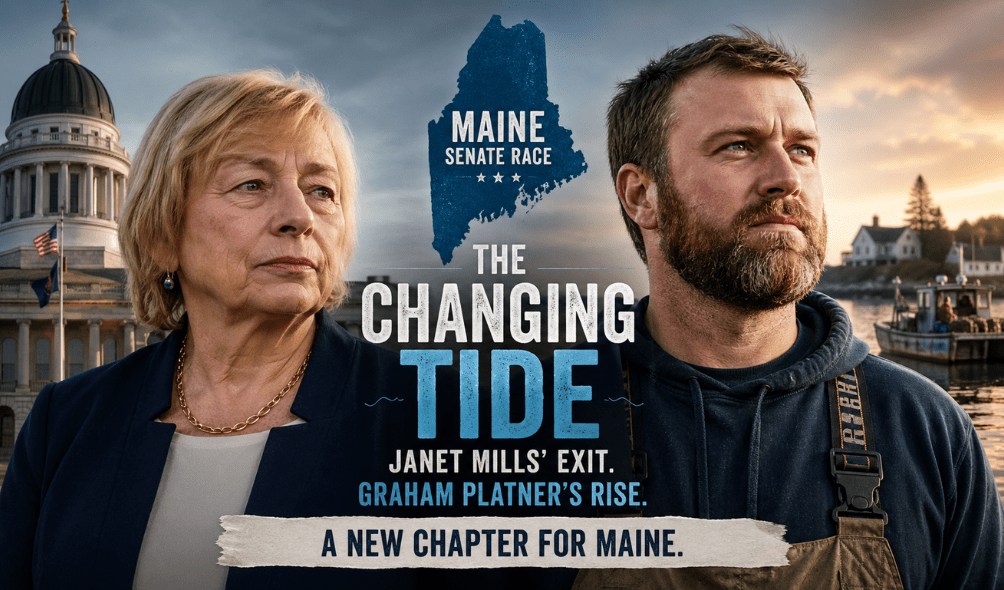
Politics is often discussed in terms of data points and strategy, but at its heart, it is a story of people and the timing of their ideas. This week, Maine’s political landscape shifted fundamentally as Governor Janet Mills made the difficult decision to suspend her Senate campaign. For Mills, a 77-year-old trailblazer with a lifetime of service, the moment was a sobering realization that the “old guard” path she represented was hitting a wall of new, restless energy personified by Graham Platner.
When Mills stepped into the race last October, she didn’t just bring a resume; she brought the weight of the Democratic establishment. Backed by Senate Minority Leader Chuck Schumer, her campaign was built on the rock-solid belief that her name recognition and steady hand were the only ways to defeat Senator Susan Collins. But while the establishment was looking at spreadsheets, a younger generation was looking for a voice that sounded like their own.
Table of Contents
The Quiet Weight of the Decision
Suspending a campaign is never just a strategic pivot; it is a deeply personal admission of a closing door. On Thursday, when Mills stepped aside just weeks before the June 9 primary, it wasn’t because she lacked the “fight,” as she put it, but because the modern political machine requires a specific kind of fuel: momentum and money.
While Mills focused on the traditional levers of power, the ground was shifting beneath her. The decision to withdraw reveals a growing rift in the Democratic Party—a tension between the “electable” veterans and the untested outsiders who are promising to lead with their hearts on their sleeves rather than a playbook in their hands.
The Human Toll of the Campaign Trail
For Mills, the struggle was visible. Despite her deep roots in Maine, she found it increasingly difficult to keep pace with the frantic energy of the Platner campaign. Politics is a game of endurance and for a governor who has spent decades navigating the halls of power, the sudden surge of an oyster farmer half her age felt like a tide that couldn’t be turned.
In the end, the numbers told a story of disconnection. Platner’s $4.1 million in first-quarter donations didn’t just represent cash; they represented thousands of individual people betting on a newcomer. By the time a February poll showed Mills trailing by nearly 40 points, the “inevitability” of her candidacy had vanished.
Graham Platner: From the Coast to the Capitol
Graham Platner is not your typical Senate candidate. He is a military veteran and an oyster farmer, a man whose hands are more accustomed to the cold waters of the Maine coast than the polished mahogany of Washington D.C. His rise wasn’t crafted in a consultant’s office; it grew out of town halls and a platform that spoke directly to the anxieties of working-class Mainers.
The Power of Authentic Connection
Platner’s appeal lies in his willingness to be blunt. He has railed against the “ultra-wealthy” and called for a complete overhaul of Democratic leadership. This didn’t just earn him votes; it earned him the mentorship of Senator Bernie Sanders and the praise of Representative Alexandria Ocasio-Cortez. For those who feel ignored by the traditional political process, Platner’s “hustle”—as one donor described it—felt like a breath of fresh air in a stale room.
Facing the Ghosts of the Past
The journey hasn’t been a clean ascent for Platner. Like many who grew up in the digital age, his past followed him into the present. Social media posts from over a decade ago surfaced, containing comments that Platner himself now describes as “offensive” and “the worst version” of who he was.
He also had to address a tattoo from his youth that resembled a controversial symbol. Rather than hiding behind a press secretary, Platner took to the screen, looking directly into the camera to ask Maine for a second chance. “Don’t judge me for the worst thing I said on the internet on my worst day 14 years ago,” he pleaded. It was a moment of vulnerability that seemed to strengthen, rather than weaken, his bond with supporters who value honesty over perfection.
Also Read: Supreme Court Voting Rights Ruling Sparks Hope, Fear and Political Divide in the US
The Failure of the Attack Ad
The Mills campaign attempted to use these past mistakes to regain footing, running ads that featured women expressing genuine outrage at Platner’s old comments. However, in an era where many people feel the system is broken, voters seemed more willing to forgive a man for his past words than a system for its perceived inaction. The ads felt like a “political hit” rather than a genuine concern and the needle didn’t move.
A Watershed Moment for the Party
Janet Mills’ departure is a stinging reality check for the Democratic Senatorial Campaign Committee and Chuck Schumer. It serves as a reminder that “electability” is defined by the voters, not the party leaders. While Schumer has seen success in other states, Maine has proven that grassroots passion can override institutional backing.
Platner, who has openly called for a change in Senate leadership, now finds himself in an uneasy alliance with the very people he criticized. The party is coalescing around him, but the tension remains palpable.
The Final Stand: Platner vs. Collins
Now, the stage is set for a clash of identities. On one side is Senator Susan Collins, the quintessential Maine politician known for her moderate, careful approach. On the other is Graham Platner, the fiery outsider who wants to tear down the walls.
The GOP Response and the Human Element
Republicans are already preparing their defense, focusing on the very “extremism” and past mistakes that Platner has spent months addressing. Senator Tim Scott and others are ready to make the race about Platner’s character.
Yet, as Senator Collins herself noted in a rare moment of personal grace, Janet Mills deserves respect for her “decades of service.” As the dust settles on the primary, the focus shifts from a battle between Democrats to a battle for the soul of Maine. It is no longer just about who can win, it’s about who Maine believes truly understands their lives.