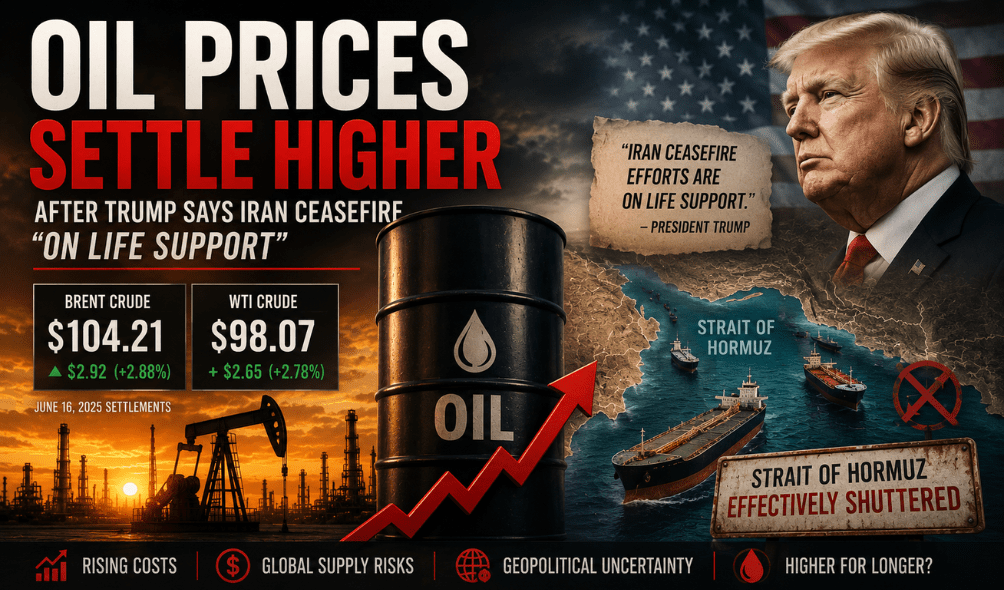
HOUSTON – The global energy market felt a sharp chill on Monday as the fragile hope for peace in the Middle East seemed to slip further away. For weeks, families and businesses worldwide had watched for signs of a breakthrough that might ease the strain on their wallets and the tension in the region. Instead, they were met with a sobering reality: oil prices settle higher after Trump says Iran ceasefire efforts are currently “on life support,” leaving the critical Strait of Hormuz effectively shuttered.
Table of Contents
A Week of Hope Replaced by Market Anxiety
Just a few days ago, there was a sense of cautious optimism. Oil benchmarks had actually dropped about 6% last week, fueled by the collective prayer of the international community that the 10-week-old conflict was nearing a conclusion. Traders, much like the average consumer, were looking for any excuse to believe that the flow of energy and the safety of the region, was about to be restored.
However, that sentiment vanished on Monday. Brent crude futures climbed $2.92 to settle at $104.21 a barrel, while U.S. West Texas Intermediate (WTI) rose $2.65 to land at $98.07. These aren’t just numbers on a ticker; they represent rising costs for transport, heating, and manufacturing that ripple through every household. The fact that oil prices settle higher after Trump says Iran ceasefire talks are failing serves as a blunt reminder of how closely our daily lives are tied to distant diplomatic tables.
The Human Toll of a Failed Dialogue
The breakdown in negotiations isn’t just a matter of policy; it’s a clash of fundamental demands. President Trump’s characterization of the situation followed his dismissal of Tehran’s latest proposal, which he described as “totally unacceptable.”
The Weight of Tehran’s Demands
From Iran’s perspective, the proposal wasn’t just about oil; it was about the survival of their sovereignty and the end of a crushing naval blockade. Their demands reached deep into the regional roots of the conflict, touching on:
- Restoration of oil sales and the lifting of economic sanctions.
- Compensation for the widespread damage caused by the ongoing war.
- The complex, violent struggles involving Israel and Hezbollah militants.
A Rapidly Changing Narrative
The shift in tone has been jarring. Florence Schmit, an energy strategist at Rabobank, noted that the narrative swung from “de-escalatory” to “escalatory” in just a few days. For those watching the headlines, the sudden pivot suggests that the path to a peaceful Strait of Hormuz is much longer and more treacherous than previously hoped.
The Global Struggle for Stability
The physical impact of this conflict is staggering. The world has essentially “lost” about 1 billion barrels of oil over the last two months. Saudi Aramco CEO Amin Nasser pointed out on Sunday that even if the gates were thrown open tomorrow, the energy markets would not simply snap back to normal. The damage to the supply chain is deep, and the healing process will be slow.
OPEC’s Difficult Position
The conflict has forced the hand of oil-producing nations. OPEC’s output in April plunged to its lowest point in over two decades, dropping to 20.04 million barrels per day. This isn’t necessarily a choice, but a forced reaction to a war that has effectively padlocked one of the world’s most vital maritime arteries. When oil prices settle higher after Trump says Iran ceasefire hopes are dimming, it reflects a world running on a dangerously low reserve.
Finding a Way Around the Blockade
In a desperate attempt to keep the world moving, some tankers have resorted to “dark” shipping—turning off their trackers to navigate the dangerous waters of the strait. Meanwhile, countries like Japan are looking toward Azerbaijan to fill the void. These are temporary bandages on a much larger wound.
Looking Toward the East for Answers
As the week progresses, the focus shifts to Beijing. President Trump is scheduled to meet with Chinese President Xi Jinping on Wednesday. It is a meeting weighted with the expectations of a global audience. While energy directors like Bob Yawger suggest that markets may hold their breath during these talks, the underlying anxiety remains high.
The Long Road to 2026
The current forecast is a difficult one to swallow. Analysts at JPMorgan believe we will be living with oil prices in the $100 range for the foreseeable future, potentially averaging $97 even as we move into 2026. This reality underscores that as oil prices settle higher after Trump says Iran ceasefire efforts have stalled, the “new normal” for energy is likely to be characterized by high costs and persistent uncertainty.
Also Read: Middle East Crisis – Trump Rejects Iran Peace Plan as Ceasefire Frays