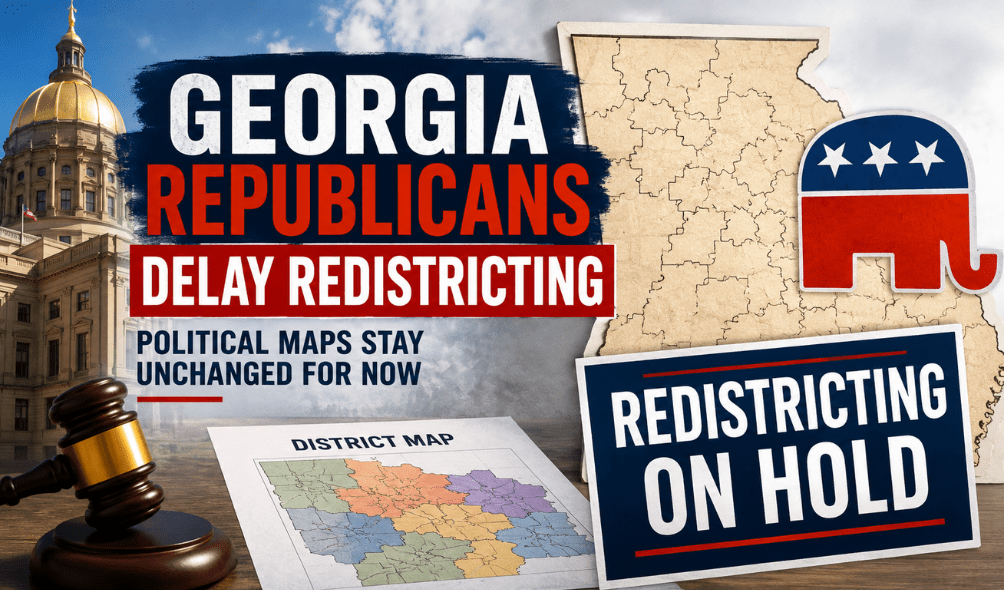
Georgia lawmakers have decided against moving forward with congressional and legislative redistricting during the state’s current special legislative session, signaling a temporary pause in a politically significant issue that could shape future elections.
The decision comes after Governor Brian Kemp called lawmakers back to the Capitol to consider new political maps following a major U.S. Supreme Court ruling on redistricting earlier this year. However, Republican leaders concluded that the available timeframe was insufficient for such an important undertaking.
The move preserves Georgia’s existing electoral maps for now and delays any potential changes until closer to the 2028 election cycle.
Table of Contents
Republican Leaders Cite Need for Transparency and Public Participation
During a press conference at the Georgia State Capitol, senior Republican lawmakers emphasized that redistricting should not be rushed and must include opportunities for public review and engagement.
House Speaker Jon Burns said legislative leaders believed the current special session was not the appropriate venue for a complex process that carries long-term implications for voters and communities across the state.
Republicans argued that any changes approved during the current session would not take effect until 2028, making it unnecessary to accelerate the process without adequate preparation.
Focus on a Deliberate Approach
According to legislative leaders, drawing new district boundaries requires careful consideration, transparency, and sufficient public input. They maintained that postponing the effort would allow lawmakers to conduct the process more responsibly if it is revisited in the future.
State Senate President Pro Tempore Larry Walker III indicated that the issue remains on the table and could return to the legislative agenda before the next redistricting deadline.
Democrats Celebrate the Decision
Democratic lawmakers welcomed the announcement, describing it as a victory for voters and community advocates who opposed reopening the redistricting process.
Party leaders argued that proposed changes could have altered political representation and potentially weakened protections for minority communities. Following the Republican announcement, Democratic leaders praised public engagement and activism that helped draw attention to the issue.
Concerns Over Electoral Fairness
Democrats have consistently raised concerns about redistricting efforts in Republican-controlled states, arguing that changes to district boundaries can influence electoral outcomes and representation.
The decision to delay action was viewed by Democratic officials as an opportunity to maintain the current political landscape while broader debates over voting rights and district maps continue nationwide.
Political Calculations May Have Influenced the Decision
The redistricting debate arrives during a critical election year in Georgia, where voters are preparing to elect a new governor and make decisions in several competitive statewide races.
Political observers noted that pursuing redistricting ahead of closely contested elections could have energized opposition voters and intensified political tensions across the state.
Reports suggested some Republican strategists were concerned that reopening district map debates could become a major campaign issue and potentially benefit Democratic turnout efforts.
Control of State Government Remains Crucial
If Republicans intend to revisit redistricting before the 2028 elections, maintaining control of state government will be essential.
With Governor Brian Kemp not seeking another term, Georgia’s upcoming gubernatorial race has gained significant attention. Republican businessman Rick Jackson secured his party’s nomination and is set to face former Atlanta Mayor Keisha Lance Bottoms in the general election.
The outcome of the race, along with legislative contests, could influence whether future redistricting proposals gain momentum.
Supreme Court Ruling Continues to Shape Redistricting Efforts
Georgia’s debate is part of a larger national conversation about congressional maps and electoral representation.
A recent Supreme Court decision has prompted several Republican-led states to revisit district boundaries that were previously protected under federal voting rights interpretations. Supporters argue states should have greater flexibility in designing districts, while critics warn that minority representation could be affected.
The ruling has sparked renewed political battles across multiple states and increased attention on how electoral maps are drawn.
Other States Move Forward With New Maps
Several Southern states, including Alabama, Florida, Louisiana, and Tennessee, have already implemented revised congressional maps ahead of upcoming elections.
Meanwhile, some states are taking a more cautious approach. Mississippi is reportedly looking toward future election cycles for potential map adjustments, while lawmakers in South Carolina and Indiana have resisted efforts to redraw districts before the next major elections.
These differing approaches highlight the continuing national divide over redistricting policy and electoral representation.
What Happens Next?
Although Georgia lawmakers have stepped back from redistricting for now, the issue is far from settled.
Republican leaders have left open the possibility of revisiting congressional and legislative maps before the 2028 elections. Future action will likely depend on election outcomes, political priorities, legal developments, and public opinion.
For now, Georgia’s existing district maps remain in place, providing temporary certainty while the broader national debate over redistricting continues to evolve.
Also Read: Trump Criticizes Netanyahu Over Lebanon Strikes Amid Push for Regional Peace