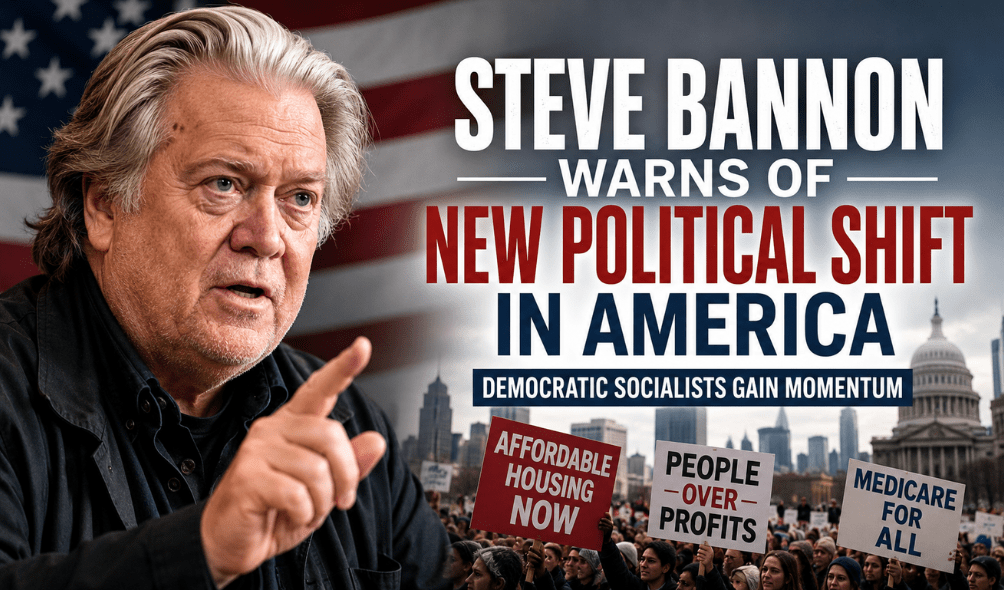
Former White House strategist Steve Bannon believes the United States is witnessing a major political realignment, one that could reshape both major parties in the years ahead. His comments come as a new generation of progressive and democratic socialist candidates continue to score unexpected victories in Democratic primaries across the country.
According to Bannon, recent election results show that political movements built on grassroots activism and voter engagement are becoming increasingly influential, while traditional campaign strategies centered on money, endorsements and party machinery are losing effectiveness.
The latest example came in Colorado, where democratic socialist candidate Melat Kiros defeated a long-serving Democratic incumbent in a primary contest. The victory followed a series of successful campaigns backed by progressive groups in New York, including candidates aligned with Zohran Mamdani.
Table of Contents
Beyond New York: Progressive Organizing Expands Its Reach
For months, many political observers viewed progressive victories in New York as unique to the city’s political landscape. However, Bannon argues that recent developments suggest a broader national trend.
He believes the success of democratic socialist candidates in places outside New York demonstrates that the movement’s appeal is no longer confined to large urban centers on the East Coast. The Colorado result, in particular, has strengthened arguments that progressive organizing efforts are resonating with voters in different regions of the country.
Bannon said political insiders underestimated the importance of grassroots organizing and overestimated the value of financial advantages. He pointed to campaigns that relied heavily on volunteers, door-to-door outreach and direct voter contact rather than large advertising budgets.
According to his assessment, campaigns that build strong personal connections with voters are increasingly outperforming opponents who depend primarily on fundraising, media endorsements and institutional support.
Why Ground Campaigns Are Becoming More Important
One of Bannon’s central arguments is that modern elections are increasingly driven by voter participation rather than campaign spending alone.
He contends that successful progressive campaigns have combined extensive volunteer networks with consistent community outreach. These efforts, he says, have created enthusiasm among supporters and helped candidates overcome significant financial disadvantages.
The strategy resembles techniques used in previous insurgent political movements. Bannon compared today’s progressive organizing efforts to the grassroots energy seen during major political shifts of the past decade.
In his view, candidates who can mobilize dedicated supporters and maintain direct communication with voters possess a growing advantage in competitive elections.
Comparing the Progressive Movement to the Tea Party
When discussing the current political landscape, Bannon drew parallels between the rise of democratic socialist candidates and the emergence of the Tea Party movement more than a decade ago.
He described the progressive surge as a movement challenging its own party’s establishment, much like the Tea Party challenged traditional Republican leadership.
However, Bannon argued that the two movements differ significantly in ideology. While acknowledging similarities in anti-establishment messaging and grassroots activism, he said today’s progressive candidates are pursuing a distinct political agenda that appeals to voters frustrated with existing institutions.
He also noted that many of these candidates focus their campaigns on dissatisfaction with party leadership rather than making opposition to President Donald Trump their primary message.
Growing Frustration With Political Establishments
The success of insurgent candidates has fueled a broader debate about whether voters are responding to specific policy proposals or expressing frustration with established political figures.
Bannon believes anti-establishment sentiment is a major factor. He argues that many voters increasingly feel disconnected from traditional party leadership and are looking for candidates who present themselves as outsiders willing to challenge the status quo.
This trend, he says, is creating difficulties for Democratic leaders attempting to contain progressive challenges within their own party. At the same time, he warned that Republicans could face similar challenges if they fail to address voter concerns with compelling economic proposals.
Republicans Face Questions About Their Response
While criticizing progressive policies, Bannon also argued that Republican leaders have not developed an effective response to the movement’s economic messaging.
He suggested that simply attacking proposals such as rent relief or housing assistance is unlikely to resonate with voters who are struggling with rising living costs.
Instead, Bannon believes Republicans need to advance their own populist economic agenda focused on family stability, housing affordability and broader economic opportunity.
According to him, voters are demanding practical solutions to everyday financial pressures and parties that fail to address those concerns risk losing support regardless of ideological affiliation.
Housing Costs and Economic Anxiety Remain Key Issues
Housing affordability emerged as a central theme in Bannon’s assessment of current political trends.
He argued that progressive candidates have successfully connected with voters by highlighting economic frustrations, particularly rising rents and the cost of living.
While disagreeing with many of the proposed solutions, Bannon acknowledged that the underlying concerns are genuine and cannot be dismissed.
Political strategists across the spectrum increasingly view housing, wages and economic security as issues likely to shape future elections. Candidates who effectively address those concerns may gain an advantage with voters seeking tangible improvements in their daily lives.
Looking Ahead to 2028
Although attention is already beginning to shift toward the next presidential race, Bannon said the larger story is the transformation currently taking place across the political system.
He argued that emerging forces such as artificial intelligence, economic concentration, technological change and growing public distrust of institutions are reshaping political priorities.
According to Bannon, leaders who continue to rely on traditional political formulas may struggle to adapt to an electorate that is demanding new approaches and more direct engagement.
He described the current period as one of significant transition, with competing political movements seeking to define the future direction of the country.
A Warning for Both Parties
Bannon’s message was directed not only at Democrats but also at Republicans. He warned that both parties risk misunderstanding the scale of the political changes underway.
While he believes progressive candidates have built an increasingly effective grassroots infrastructure, he also argues that Republican leaders must rethink how they communicate with voters and address economic concerns.
The recent victories by democratic socialist candidates have intensified discussions about the future of American politics, raising questions about how traditional party establishments will respond to growing demands for political and economic change.
As new candidates continue to challenge long-established political figures, the debate over populism, grassroots activism and voter engagement is likely to remain a defining feature of U.S. elections in the years ahead.