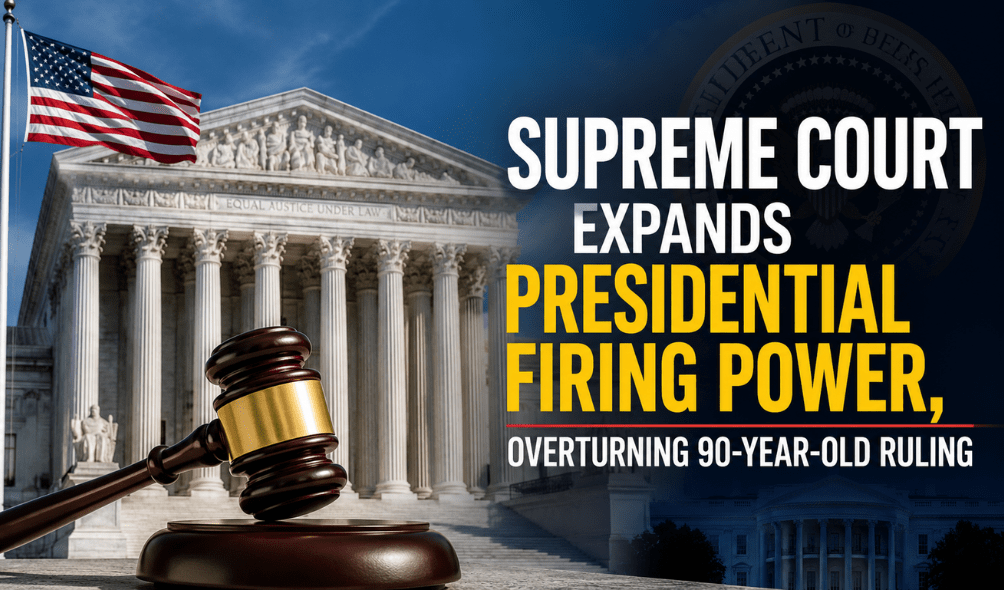
The U.S. Supreme Court has delivered a landmark ruling that significantly broadens presidential authority over independent federal agencies, striking down long-standing protections that limited a president’s ability to remove certain agency officials.
In a closely watched decision, the nation’s highest court ruled that restrictions preventing the president from firing members of the Federal Trade Commission (FTC) without cause are unconstitutional. The judgment overturns a legal precedent that had stood for nearly 90 years and is expected to reshape the balance of power between the White House and a wide range of federal regulatory bodies.
The ruling marks another major development in the ongoing debate over executive authority and the independence of federal agencies.
Table of Contents
Supreme Court Issues 6-3 Decision
The court’s decision was delivered in a 6-3 ruling, with the conservative majority concluding that officials who exercise executive authority on behalf of the president must remain subject to presidential control.
Writing for the majority, Chief Justice John Roberts stated that limits on the president’s ability to remove executive officers interfere with constitutional executive powers. According to the court, the modern FTC exercises substantial executive authority and therefore cannot remain insulated from presidential oversight through statutory removal protections.
Majority Says Accountability Requires Presidential Control
The majority emphasized that officials carrying out executive responsibilities must ultimately answer to the president, who is in turn accountable to voters.
The court reasoned that allowing Congress to protect such officials from removal weakens the president’s constitutional responsibility to oversee the executive branch effectively.
By reaching this conclusion, the justices overturned the long-standing legal framework established in a 1935 Supreme Court decision involving the FTC.
End of a 90-Year-Old Legal Precedent
For decades, federal law allowed Congress to create independent agencies whose leaders could only be removed under specific circumstances, such as inefficiency, neglect of duty, or misconduct.
That arrangement stemmed from a landmark 1935 Supreme Court ruling that upheld congressional authority to shield certain agency officials from dismissal at the president’s discretion.
Historic Protection for Independent Agencies Removed
The newly issued decision eliminates that protection for FTC commissioners and signals a broader shift in how independent agencies may be structured in the future.
Legal experts view the ruling as one of the most consequential decisions concerning executive power in recent years because it directly affects the relationship between the presidency and regulatory institutions.
The court’s decision also reflects a gradual movement away from earlier interpretations that treated independent agencies as partially insulated from political influence.
Impact Expected Across Federal Agencies
While the case specifically involved the FTC, its implications are expected to extend far beyond the agency.
Numerous federal commissions and boards currently operate under statutes that permit removal of members only for cause. Those agencies could now face legal and structural challenges as a result of the Supreme Court’s decision.
Agencies Potentially Affected
Several prominent federal bodies may be influenced by the ruling, including:
- The Federal Energy Regulatory Commission
- The Nuclear Regulatory Commission
- The National Labor Relations Board
- Other multi-member regulatory commissions created by Congress
Because many of these organizations play critical roles in energy regulation, labor policy and consumer protection, the decision could have far-reaching consequences for federal governance.
Questions About Future Independence
The ruling raises new questions about whether independent commissions can continue operating with the level of autonomy Congress originally intended.
Observers expect additional litigation and policy debates as lawmakers, agencies and courts assess the practical effects of the decision.
Liberal Justices Warn of Expanded Executive Power
The court’s three liberal justices strongly disagreed with the majority’s reasoning and conclusions.
In a dissenting opinion, Justice Sonia Sotomayor argued that the ruling fundamentally alters the structure of government by placing greater authority in the hands of the president.
Dissent Highlights Concerns Over Concentrated Authority
The dissent warned that agencies established to operate independently may now become more directly controlled by the executive branch.
According to the dissenting justices, Congress intentionally created these commissions to function with a degree of separation from political pressure, allowing them to make decisions based on expertise and long-term policy objectives.
The dissent suggested that removing those protections could transform the role and character of dozens of federal agencies.
President Trump Welcomes the Decision
President Donald Trump praised the ruling shortly after it was announced, describing it as a major expansion of presidential authority.
The decision aligns with the administration’s broader efforts to increase executive control over federal agencies and remove officials viewed as out of step with White House priorities.
A Key Victory for the Administration
Since returning to office in January 2025, President Trump has pursued an aggressive approach toward restructuring federal agencies and replacing officials appointed by previous administrations.
The Supreme Court’s ruling provides significant legal support for those efforts and strengthens the president’s ability to shape the leadership of federal commissions.
How the Rebecca Slaughter Case Reached the Supreme Court
The dispute originated with the removal of Rebecca Slaughter from the Federal Trade Commission.
Although originally appointed to the FTC during President Trump’s first term and later reappointed by President Joe Biden, Slaughter was dismissed in March 2025.
The administration informed her that her continued service did not align with its priorities.
Legal Challenge Followed Dismissal
Slaughter challenged her removal in federal court, arguing that the action violated the law governing the FTC.
Under the statute that established the commission, members could traditionally be removed only for inefficiency, neglect of duty, or malfeasance in office.
A federal district court ruled in her favor and ordered her reinstatement. An appeals court later allowed her to continue serving while legal proceedings continued.
However, the Supreme Court subsequently permitted her removal while reviewing the broader constitutional issues surrounding agency protections.
That review ultimately resulted in Monday’s landmark ruling.
Federal Reserve Protections Remain Untouched
Although the decision affects many independent agencies, the Supreme Court emphasized that it does not currently apply to the Federal Reserve.
The court has previously suggested that the Fed occupies a unique position within the federal government due to its historical structure and specialized role.
Certain Questions Reserved for Future Cases
The justices also indicated that the ruling does not address protections for judges serving on specialized federal courts, including the U.S. Tax Court and the Court of Federal Claims.
By drawing these distinctions, the court left open the possibility that future cases may address additional constitutional questions involving agency independence and removal protections.
Part of a Broader Trend Expanding Executive Authority
The latest ruling continues a pattern of Supreme Court decisions that have steadily increased presidential control over executive branch officials.
In recent years, the court struck down removal protections for the director of the Consumer Financial Protection Bureau and the head of the Federal Housing Finance Agency.
Long-Term Consequences Yet to Be Determined
Legal scholars expect the FTC decision to become one of the most influential rulings on executive power in modern history.
Its effects are likely to be felt across federal agencies, future administrations and ongoing debates about the constitutional limits of presidential authority.
As courts, lawmakers and regulators evaluate the ruling’s implications, the decision is expected to shape the structure of the federal government for years to come.