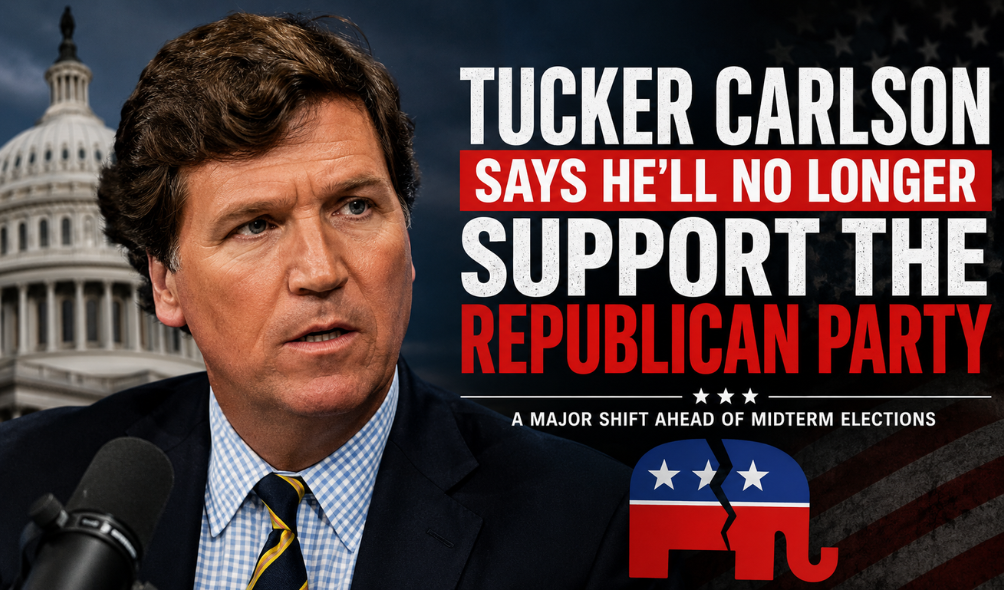
Longtime conservative commentator Tucker Carlson has declared that he no longer intends to support the Republican Party, marking a significant political shift from a media figure who spent decades defending conservative causes and Republican leadership.
Speaking during a recent appearance on the podcast “Can’t Be Censored,” Carlson said he does not plan to back either major political party in the upcoming midterm elections. His remarks come amid growing frustration with the direction of Republican leadership and months after publicly expressing regret over his support for President Donald Trump during the 2024 election cycle.
Table of Contents
Carlson Distances Himself From Both Major Parties
While discussing the current political landscape, Carlson made it clear that he is stepping away from the Republican Party. However, he also emphasized that he has no intention of aligning himself with the Democratic Party.
No Political Home at the Moment
According to Carlson, he is uncertain about where his political support will go in the future. His comments suggest a broader dissatisfaction with the two-party system and reflect concerns he believes are shared by many voters who feel politically unrepresented.
The statement represents one of Carlson’s strongest criticisms of the Republican Party despite his long-standing association with conservative politics.
Growing Disillusionment After Trump and Iran Conflict
Carlson’s frustration with Republican leadership appears to have intensified following President Donald Trump’s decision to engage in military action involving Iran earlier this year.
Regret Over Supporting Trump
Carlson, who publicly supported Trump’s 2024 presidential campaign, later expressed regret about that endorsement. He stated that he felt he had unintentionally misled supporters by backing a candidate whose actions ultimately conflicted with expectations held by many conservative voters.
The commentator has since become one of the most vocal critics of the conflict, arguing that the decision did not align with the interests of ordinary Americans.
Sharp Criticism of Republican Leadership
A major theme of Carlson’s recent comments centers on his belief that Republican leaders are prioritizing interests other than those of American citizens.
Concerns Over Political Priorities
Carlson argued that political decisions are increasingly being shaped by donor influence, corporate interests and foreign policy considerations rather than the concerns of voters.
He described such decision-making as unacceptable and suggested that elected officials should place national interests and citizen concerns at the center of policy discussions.
His criticism reflects a growing divide within some conservative circles regarding the future direction of the Republican Party and its policy priorities.
A Significant Shift From a Longtime Party Defender
For decades, Carlson was widely recognized as one of the most influential conservative voices in American media. From his years in television broadcasting to the large audience he has built through independent media platforms, he consistently defended Republican positions and candidates.
Carlson Says He Can No Longer Defend the Party
During the podcast discussion, Carlson acknowledged that he had spent roughly 35 years supporting and defending the Republican Party. However, he stated that current developments have made continued support impossible in his view.
He further suggested that many other conservatives may be reconsidering their loyalty to the party as well, potentially signaling broader dissatisfaction among sections of the Republican voter base.
What Carlson’s Comments Could Mean Going Forward
Carlson’s decision to publicly distance himself from the Republican Party adds another dimension to ongoing debates within the conservative movement. As one of the most recognizable political commentators in the United States, his views carry influence among millions of followers.
Whether his stance reflects a wider trend among conservative voters remains to be seen. However, his remarks highlight growing tensions over leadership decisions, foreign policy and the future identity of the Republican Party ahead of the next major election cycle.
Also Read: California Universal Healthcare Plan Faces Major Economic and Political Challenges, New Report Finds