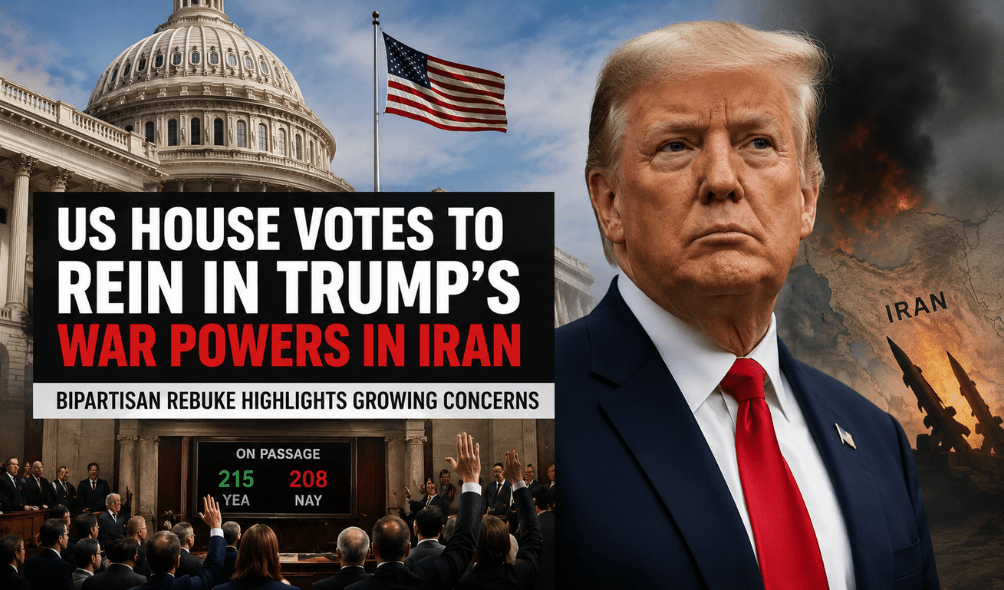
The US House of Representatives has approved a measure seeking to restrict President Donald Trump’s authority to continue military operations against Iran, delivering a rare bipartisan rebuke of the administration’s handling of the conflict.
The resolution passed by a narrow 215-208 vote after four Republican lawmakers joined Democrats in support of the measure. The outcome reflects growing concern among some members of Congress over the president’s war powers and the risk of deeper US involvement in the Middle East.
Although the resolution cleared the House, it still faces an uncertain future in the Republican-controlled Senate. Even if it advances further, it is unlikely to completely prevent military action against Iran.
Table of Contents
House Moves to Reassert Congressional Authority
The vote marks the latest effort by lawmakers to reassert Congress’s constitutional role in decisions involving war and military force.
Supporters of the measure argue that military operations of this scale should not continue without approval from Congress. They say lawmakers must have a greater say in decisions that could lead to a prolonged conflict and place American forces at further risk.
This is the fourth time the House has attempted to limit Trump’s authority regarding military action involving Iran.
Republicans Break Ranks
The resolution’s passage was made possible by a small group of Republicans who chose to vote against their party’s leadership.
Representatives Thomas Massie, Brian Fitzpatrick, Tom Barrett and Warren Davidson joined Democrats in supporting the measure. Their votes underscored growing unease within parts of the Republican Party about the direction of US policy toward Iran.
Democratic Representative Jared Golden of Maine, who had opposed similar efforts in the past, also voted in favour of the resolution.
Speaking after the vote, Barrett stressed the importance of Congress’s constitutional responsibility in matters of war.
“Congress alone declares war,” he said, adding that lawmakers must remain protective of that authority. When asked whether he feared political consequences for opposing the president, Barrett said he was voting according to his conscience.
Senate Vote Remains Uncertain
While the House vote represents a significant political statement, the measure still faces major challenges before it can have any practical effect.
A similar resolution previously advanced in the Senate after several unsuccessful attempts, but it has not yet reached a full vote before the chamber.
With Republicans holding control of the Senate, its chances of success remain unclear. Even if approved, legal and constitutional questions could limit its ability to fully restrain presidential military authority.
Growing Divisions Within the Republican Party
The vote also highlighted continuing divisions within Trump’s own party.
It comes only days after conservative lawmakers pushed back against a proposed $1.8 billion “anti-weaponization” fund, prompting the administration to reconsider its plans.
Taken together, the developments suggest that disagreements within Republican ranks are becoming more visible, particularly on issues involving executive power and foreign policy.
Democrats Call Vote a Turning Point
Representative Gregory Meeks, the leading Democrat on the House Foreign Affairs Committee and a co-sponsor of the resolution, described the outcome as an important step toward ending the conflict.
According to Meeks, the war has failed to achieve its stated goals while increasing economic pressure at home and making diplomatic efforts with Iran more difficult.
He argued that more Republicans are beginning to reflect the concerns of voters who do not want the United States drawn into another long-running conflict in the Middle East.
“The passage of this measure today signals a significant turning point,” Meeks said, pointing to growing bipartisan frustration with the war.
Conflict Continues Despite Ceasefire Efforts
The current crisis began after the United States and Israel launched strikes against Iran on February 28.
Iran responded with attacks on Israel and US-aligned countries in the Gulf region. The confrontation also disrupted global trade after Tehran effectively closed the Strait of Hormuz, a critical route for international energy shipments and commercial shipping.
In April, Washington announced a blockade targeting vessels travelling to and from Iran’s coastline.
Military Exchanges Persist
Although the United States and Iran reached an initial ceasefire agreement on April 8, fighting has not fully stopped.
Recent US strikes inside Iran have been followed by retaliatory attacks from Tehran, including strikes targeting Kuwait, a close American ally in the Gulf.
The continued exchange of military action has raised concerns that efforts to reduce tensions remain fragile.
Trump Says Diplomacy Is Making Progress
Despite the ongoing conflict, President Trump has expressed confidence that negotiations could soon produce a breakthrough.
Speaking to reporters at the White House ahead of the House vote, Trump said talks with Iran were progressing well and suggested an agreement could be reached in the coming days.
The president acknowledged recent military operations while describing them as part of the broader situation between the two countries.
“We hit them pretty hard,” Trump said, while adding that both sides were responding to developments on the ground.
Trump also said members of his administration hope to end the conflict through diplomacy rather than prolonged military action.
According to the president, negotiators are “pretty close” to reaching an agreement and relations during the talks have been constructive.
What Happens Next?
The House vote represents one of the clearest signs yet of congressional concern over the direction of the conflict with Iran.
Attention will now shift to the Senate, where lawmakers must decide whether to advance the measure. Regardless of the outcome, the debate has reignited questions about presidential war powers, congressional oversight and the long-term consequences of US involvement in the region.
For now, the vote stands as a significant political message from the House—one that reflects growing unease in Washington over the costs, risks and future of the conflict with Iran.
Also Read: Trump Expected to Nominate Todd Blanche as Attorney General, Setting Up Key Senate Battle