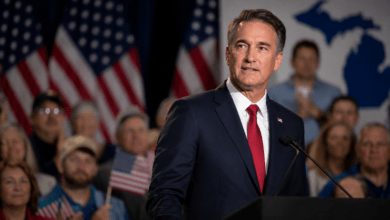
Donald Trump asserted his absolute dominance over the Republican political infrastructure on Wednesday morning, publicizing his immense primary endorsement clout following a sweeping 37-0 clean streak across national GOP primary ballots on Tuesday.
“Our movement achieved a flawless performance last night. Every single endorsed candidate emerged victorious,” Trump announced to members of the press, underscoring his tight-knit authority over the party apparatus.
The raw impact of the former president’s stamp of approval and the profound structural leverage he maintains over conservative politics—was vividly illustrated across multiple high-stakes primary contests. Most notably, the Trump-backed challenger Ed Gallrein successfully ousted incumbent Representative Thomas Massie within Kentucky’s highly contested 4th Congressional District primary, a race that rapidly evolved into a crucial referendum on intra-party fealty.
However, while Trump’s aggressive interventionism has yielded flawless results in securing conservative nominations, mainstream party strategists are increasingly anxious about the looming autumn general elections. There, campaigning Republicans must successfully defend an incredibly narrow House majority and an equally slim margin in the Senate amidst shifting independent voter sentiment.
Table of Contents
Trump-Backed Veteran Knocks Out Longtime Incumbent in High-Stakes Kentucky Face-Off
While long-term general election vulnerabilities will inevitably trigger strategic anxieties as the November midterms draw near, Tuesday’s primary results solidified an immediate narrative: Donald Trump remains highly adept at leveraging his base to exact swift political retribution against independent-minded Republicans.
This latest development follows a series of systematic purges. Just a fortnight ago, Trump successfully targeted and unseated five sitting state senators in Indiana who had opposed his favored congressional redistricting plans. Days later, he directed his political machinery to assist in unseating veteran Louisiana Senator Bill Cassidy, who was decisively defeated in his renomination campaign—years after drawing Trump’s ire for voting to convict him during the historic second Senate impeachment trial. On Tuesday, it was Massie’s turn to face the political buzzsaw.
For nearly fourteen years, Massie comfortably represented Kentucky’s deep-red 4th Congressional District in the northeastern part of the state. Known for his libertarian philosophy, Massie frequently positioned himself as one of Trump’s most visible conservative critics on Capitol Hill. He repeatedly challenged the executive branch on long-term foreign policy directions, expressing vocal skepticism regarding ongoing military deployments and foreign defense allocations. Furthermore, Massie actively agitated Trump’s inner circle by relentlessly demanding the full transparency and declassification of federal investigative archives linked to the late convicted offender Jeffrey Epstein.
Democracy ’26 – Comprehensive Coverage via the Times News Express Election Hub
Gallrein’s decisive double-digit margin of victory over Massie in a race that neutral polling suggested would be a neck-and-neck finish represents an immense victory for Trump’s campaign team and aligned pro-Israel advocacy organizations, which deployed substantial capital to dislodge the independent incumbent. Addressing a raucous victory rally, Gallrein credited the endorsement as his campaign’s primary catalyst: “Our core mission is straightforward—advancing the conservative agenda to put America first and ensure Kentucky’s interests are always protected.”
Following the confirmation of Massie’s defeat, high-ranking campaign officials took to digital networks to send an explicit warning to remaining GOP outliers. White House Communications Director Steven Cheung issued a blunt memo: “Do not underestimate Donald Trump’s political capital or his lasting authority. To cross him is to invite immediate electoral defeat.”
“The modern Republican Party belongs fully to Donald Trump. If a politician chooses to defy his agenda, the response will be overwhelming, calculated and aimed directly at primary elimination. His operational precision is sharpening with each consecutive election cycle.”
“Any conservative official who fails to recognize this baseline political reality is essentially volunteering for unemployment,” Williams added, noting the shift in intra-party dynamics.
Concurrently, other establishment-aligned, Trump-supported candidates cruised to comfortable primary victories. Representative Andy Barr secured a decisive win for the Republican Senate nomination in Kentucky, positioning himself as the frontrunner to replace retiring veteran statesman Mitch McConnell. Meanwhile, in deep-red Alabama, close Trump ally Senator Tommy Tuberville easily secured the GOP gubernatorial nomination, further demonstrating the alignment of local executive branches with Mar-a-Lago.
Primary Victories Visualized – Runoffs and Key Battleground Complications
Despite the flawless headline metric, several high-profile Trump candidates did not achieve immediate closure, facing mandatory runoffs before officially locking in their spots on the general election ballot.
In Georgia, Lieutenant Governor Burt Jones secured the top spot in a crowded Republican gubernatorial field but fell just short of the 50% absolute majority threshold required by state law. This setup triggers a high-stakes runoff next month against the well-funded billionaire executive Rick Jackson. A parallel scenario unfolded in Alabama’s Senate primary, where Trump-favored Representative Barry Moore led the initial field but must secure a secondary runoff victory next month to finalize his nomination. Meanwhile, over the weekend, Representative Julia Letlow found herself pushed into a competitive runoff environment against Louisiana Treasurer John Fleming, continuing the localized political shakeups triggered by Cassidy’s exit.
While Donald Trump’s heavy-handed endorsements carry minimal risk in deep-red bulwarks like Alabama, Kentucky or Louisiana, political analysts warn that this purist strategy introduces severe vulnerabilities in critical battleground landscapes like Georgia and Texas—where Democrats are positioning massive financial reserves to break historical cycles.
General Election Vulnerability: Primary electorates lean heavily toward ideological extremes, whereas general elections in swing states are determined by moderate, independent suburban voters who historically reject highly polarized candidates.
The High-Stakes Texas Showdown – Paxton vs. Talarico
Democratic strategists view Trump’s late-stage endorsements as a significant tactical gift, particularly in Texas, where Trump heavily backed controversial Attorney General Ken Paxton over longtime institutional conservative Senator John Cornyn just a week before the critical primary runoff.
Trump aggressively defended his choice on social media, characterizing Paxton as a “relentless fighter who has consistently delivered on conservative mandates.” This endorsement all but eliminates Cornyn’s viability for consecutive terms, shifting the structural landscape of Texas conservative leadership.
The Republican who emerges from this contentious runoff will face state Representative James Talarico in the autumn. Talarico, widely viewed as a rising star within the national Democratic Party, has successfully built a formidable campaign war chest while Paxton and Cornyn exhausted resources in a highly negative primary battle.
Senate Majority Leader John Thune, alongside leadership at the National Republican Senatorial Committee (NRSC), had consistently viewed Cornyn as the ideal candidate to protect the Texas seat from flipping. Their primary concern stems from Paxton’s extensive history of high-profile ethical controversies, complex legal battles and a highly publicized personal life, which Democrats plan to center in their general election messaging.
This dynamic mirrors the GOP’s tactical failures during the 2022 midterms, when Trump-backed nominees won highly competitive primaries but ultimately faltered in the general election, costing vacancies that hand-delivered the Senate majority to Democrats. As prominent conservative commentators noted following Tuesday’s results, dominant primary performances do not automatically translate into general election victories and prioritizing absolute personal loyalty over local electability risks handing congressional control back to the opposition.
Also Read: Ken Paxton Secures Donald Trump’s Endorsement in High-Stakes Texas Senate Showdown