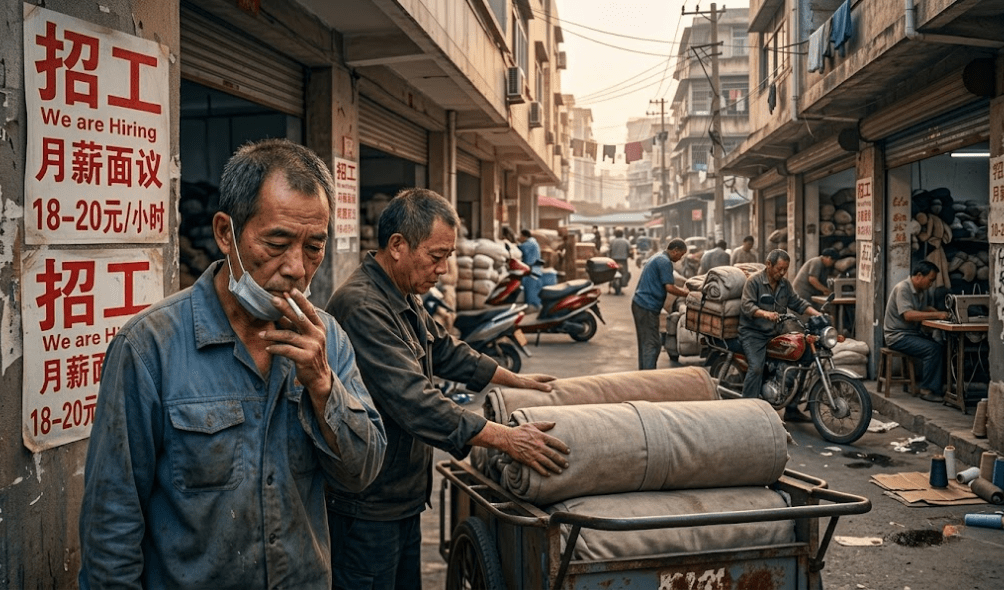
China’s Economic Resilience Tested: Behind the gleaming headlines of China’s 5% GDP growth and its surge in robotic innovation lies a quieter, more painful reality in the backstreets of its manufacturing hubs. In the industrial shadows of Guangdong, workers gather under the thin shade of trees, the smoke from their cigarettes mingling with the humid air as they stare at red-lettered recruitment signs advertising jobs that offer little more than survival.
“No one truly understands what our life is like,” says one man, his eyes weary from years of twelve-hour shifts. He speaks in low tones, a rare and risky plea for recognition. “We work, and we work, and we have no life. Please, just help us.”
These are the people caught in the gears of China’s massive “Great Pivot”. As the nation shifts its soul from cheap, mass-produced plastic to automated, advanced technology, millions of manual labourers—most over the age of 40—are finding themselves strangers in their own economy.
Table of Contents
A Collision of Two Worlds – Tariffs and War
The resilience that allowed China to weather the return of Donald Trump’s tariffs in 2025 is being tested again, but this time the pressure is coming from the Middle East. The US-Israel-Iran war has sent shockwaves through the global economy, turning the manufacturing heartland into a pressure cooker.
In Foshan, the “world’s factory” for household goods, the struggle for a living wage is stark. Workers are offered between 18 and 20 yuan (roughly $2.50) per hour to screw together smartphone parts or mold plastic. For those who travelled hundreds of miles from rural provinces to build a better life, these wages are no longer enough to keep the dream alive.
“I’m going to try my luck elsewhere,” says a middle-aged worker, though his voice lacks conviction. Uncertainty has become the only constant.
The Silent Crisis in the Fabric Markets
In Guangzhou, an hour’s drive away, the world’s largest textile market pulses with a frantic, desperate energy. Motorbikes weave through the narrow streets, laden with rolls of vibrant silk and nylon, but the conversations in the backrooms are sombre.
The textile trade relies on a steady flow of oil-based petrochemicals—the very lifeblood currently being choked at the Strait of Hormuz.
-
The Margin Squeeze: With raw material costs up 20%, traders are caught in a deadlock.
-
The Warehouse Pile-up: Global retailers like Zara and Shein are hesitant to pay higher prices, leaving mountains of unsold fabric gathering dust in dark warehouses.
Where there was once a sense of defiance against trade wars, there is now a heavy sense of resignation.
Also Read: UK Food Prices Set to Rise Due to Middle East Conflict
The High-Tech Facade – Robots and AI
Just a few miles from these struggling markets, the Chinese government is putting on a masterclass in projection. At the Canton Fair, the air is filled with the sound of humanoid robots singing and waving to international crowds. Visitors take selfies with robotic legs designed for mountain climbing and try on AI glasses that translate languages in real-time.
This is the China Beijing wants the world to see: a nation focused on the future, seemingly unbothered by the conflicts entangling its rivals in the West.
The EV Survival Strategy
The Middle East conflict has inadvertently handed China a powerful weapon: the Electric Vehicle (EV). As petrol and diesel prices skyrocket globally, the demand for Chinese EVs has surged by 140% compared to last year.
Traders like Joyce Liu, who once sent 90% of her stock to the Middle East, are now forced to pivot. With cars sitting idle at Chinese ports due to shipping risks, they are looking toward new horizons in India, Africa, and South America. In these regions, where fuel costs are crippling, the waitlists for a Chinese-made EV are growing by the day.
A Diplomatic Game of Chess
While the workers in Foshan worry about their next meal, Beijing is playing a high-stakes game of global diplomacy. China is positioning itself as the “adult in the room”, calling for ceasefires and pushing Iran toward the negotiating table.
The May Summit Priority
Experts believe Beijing’s primary goal is stability not out of altruism, but out of necessity. They are desperate to secure a successful summit with President Trump in May to prevent further economic volatility. By flexing its diplomatic muscle, China is signalling to the world that it is no longer just a factory; it is a centre of global power.
Yet, for the woman moving heavy cylinders of fabric onto a truck or the man assembling a phone for $2 an hour, these geopolitical manoeuvres feel worlds away. They are the human foundation of a superpower, waiting for a future that seems to have forgotten them.