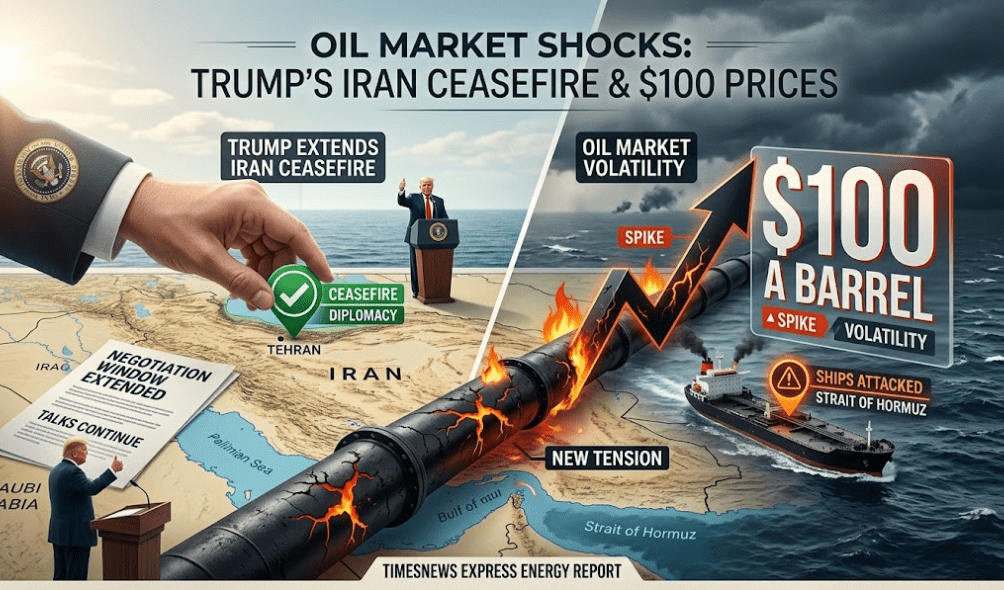
Trump Extends Iran Ceasefire Amid New Tension: The world’s energy markets felt like a rollercoaster this Wednesday as traders and everyday consumers alike watched global oil prices tumble and then surge again. The catalyst? A high-stakes announcement from US President Donald Trump, who confirmed he would extend the current ceasefire with Iran to allow more breathing room for peace negotiations.
While the extension offers a flicker of hope for a diplomatic breakthrough, the underlying tension remains thick. The White House has made it clear that the US will maintain its blockade on Iranian ports until Tehran comes to the table with a “unified proposal” that satisfies Washington’s conditions.
Table of Contents
A Day of Sharp Swings and Market Anxiety
The trading day started with a sigh of relief in Asia, where the global benchmark price for wholesale oil dipped to $97.60 (£72.14) a barrel. For a brief moment, it seemed like diplomacy might be winning the day.
However, that optimism evaporated almost as quickly as it appeared. Reports of new attacks on ships in the Strait of Hormuz, the world’s most critical energy artery, sent shockwaves through the market. Prices spiked, briefly hitting the significant $100-a-barrel mark before retreating slightly as the dust began to settle.
A Legacy of Volatility
This recent instability isn’t happening in a vacuum. Ever since the US and Israel launched strikes on Iran back on February 28, the energy sector has been in a state of constant flux. Tehran’s counter-threats to target vessels in the Strait of Hormuz have effectively put a “risk premium” on every barrel of oil traded globally.
The Extension Without a Deadline
The initial two-week ceasefire was set to expire on Wednesday evening. While the extension avoids an immediate return to large-scale military action, the President did not provide a specific new deadline. By keeping the timeline open-ended on Truth Social, the administration is keeping both the Iranian government and global markets guessing.
Also Read: UK Food Prices Set to Rise Due to Middle East Conflict
The Stalled Road to Diplomacy
The path to peace is proving to be incredibly rocky. President Trump noted that the Iranian government appears “seriously fractured”, suggesting that internal political struggles in Tehran are making it difficult for them to agree on a path forward.
Despite Pakistan’s efforts to mediate and buy more time for a deal, the diplomatic machinery seems to be grinding to a halt:
-
Vice President JD Vance, who was expected to lead high-level negotiations in Islamabad, has cancelled his trip.
-
Iranian officials told the BBC they are still undecided on whether to send their own delegation to Pakistan.
Why Expectations Rule the Market
For the average person, these geopolitical manoeuvres might feel distant but they hit home at the fuel pump. Experts, like Associate Professor Jiajia Yang from James Cook University, point out that these price spikes aren’t necessarily about a physical shortage of oil right now. Instead, it’s about “expectations”—the fear of what might happen tomorrow that drives prices up today.
The Shadow of the Strait of Hormuz
The real reason the world is holding its breath is the Strait of Hormuz. Nearly 20% of the planet’s energy supply moves through this narrow stretch of water. With Iran threatening its closure and the US intercepting ships headed for Iranian ports, the threat to global trade is real and immediate.
Until a “unified proposal” moves from a demand to a reality, the world should expect the price of oil and the stability of the global economy, to remain as unpredictable as the headlines.