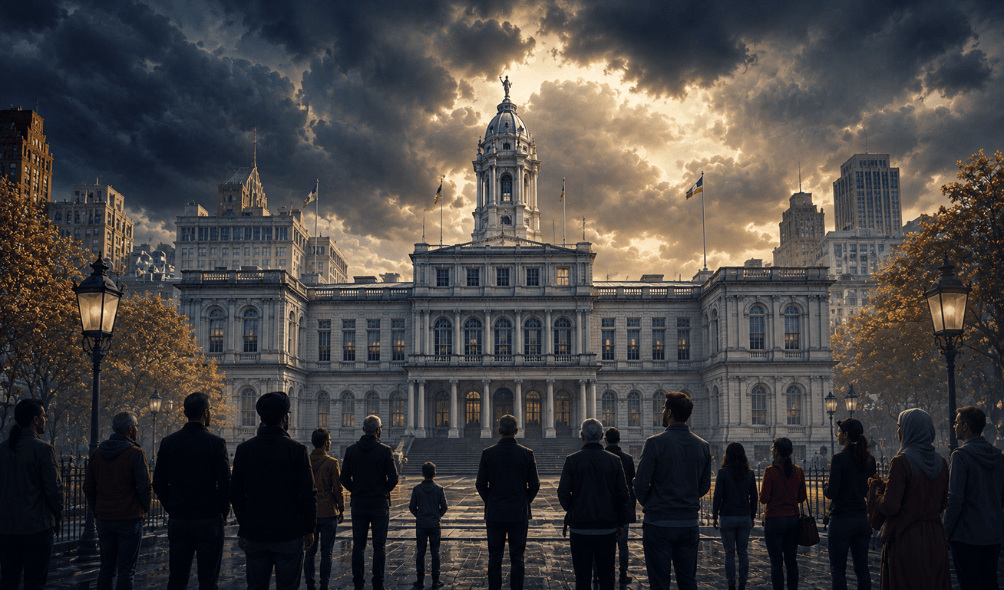
NEW YORK — Since taking office, Mayor Zohran Mamdani has upended decades of conventional wisdom about how to build and hold power in New York City. Rather than stitching together support through the city’s traditional patchwork of ethnic and neighborhood loyalties, he has assembled a coalition built largely around generation and ideology — and it has proven remarkably durable so far.
That success, however, has come at a cost. Leaders within the city’s Black, Latino and Jewish communities say they feel sidelined by City Hall, while residents of Italian and Irish descent in the outer boroughs — many of whom opposed Mamdani from the start — have watched the administration commit a string of small but symbolically loaded missteps.
For now, the numbers suggest Mamdani can afford the friction. His victories over former Gov. Andrew Cuomo in both the primary and general election were decisive, his approval ratings continue to climb and candidates he backed in last month’s Democratic primary overwhelmed established party figures so completely that strategists across the political spectrum now describe the city’s electorate in generational terms rather than the old ethnic-bloc framework.
Table of Contents
A Pattern of Overlooked Gestures
Still, political veterans warn that ignoring rival constituencies carries long-term risk, even for a mayor riding high in the polls.
“It would be smart for them to expand their coalition,” said Queens Borough President Donovan Richards, who built his own base representing Black homeowners on the City Council before winning his current office. “It’s important to reach out to communities who didn’t support you. That’s just part of good governing and coalition building.”
Individually, the episodes might seem minor. Mamdani was absent from the installation ceremony for a new archbishop, an oversight City Hall attributed to a scheduling error. Catholic New Yorkers were left out of his Independence Day remarks. A map cataloguing the city’s ethnic neighborhoods initially omitted Little Italy, provoking public frustration. A Puerto Rican Day Parade reception at Gracie Mansion was called off and then quietly reinstated. Neither Asian American and Pacific Islander Heritage Month nor Lunar New Year received a dedicated City Hall event and the mayor has generally shown little enthusiasm for the parade circuit that once defined mayoral calendars.
Taken together, these lapses break with more than three decades of mayoral tradition, in which showing up for ethnic and religious communities — even symbolically — was treated as a basic requirement of the job.
“And it’s just not their thing. They want to do their own thing for the people who were never part of the original,” said Chris Coffey, chief executive of the political consulting firm Tusk Strategies. He argued the pattern extends beyond scheduling: the neighborhood map controversy, skipped breakfasts, sparse endorsements of establishment figures and the mayor’s new outreach office all point to an administration that views legacy nonprofits and civic groups as ineffective. “I’m not saying they don’t care about these groups,” Coffey said, “but there appears to be a belief that the establishment … haven’t done a lot of it right. So they just don’t care about them as much as they care about other folks who tend to fit their electoral priorities.”
Adams Wrote the Old Playbook — Mamdani Is Ignoring It
The contrast with former Mayor Eric Adams is stark. Adams, a Democrat who shifted between moderate, conservative and populist postures throughout his tenure, treated ethnic outreach as a governing philosophy in its own right. Flag-raising ceremonies, cultural attire and shout-outs to far-flung home countries became something of a signature.
As Brooklyn borough president, Adams relied on a nonprofit — not without controversy — to underwrite a constant rotation of cultural celebrations at Borough Hall, honoring groups ranging from Greek to Ghanaian New Yorkers. That approach paid off in his 2021 mayoral campaign, when he assembled support from smaller, often-overlooked communities — Russian, Chinese and South Asian voters among them — and combined it with his broader base among Black, Latino, outer-borough white ethnic and moderate Jewish voters to win.
“No mayor in modern history was a better encapsulation of old-school ethnic politics than Eric Adams in his prime,” said Democratic strategist Trip Yang. “Zohran Mamdani is the complete opposite.”
Election analysts largely agree that age, not ethnicity, is the defining feature of Mamdani’s base. He and the candidates he has endorsed have consistently outperformed among younger voters regardless of racial or ethnic background and have also succeeded in mobilizing many first-time voters — meaningfully growing the size of the active electorate.
City Hall’s outreach strategy reflects that emphasis. Mamdani has continued expanding his social media footprint, with his Instagram account now reaching 12 million followers. He has backed fellow members of the Democratic Socialists of America, including in primary contests against established Black and Latino candidates. And his newly created Office of Mass Engagement is designed to keep his volunteer network active between elections through direct, campaign-style canvassing. That shift has left more conventional engagement channels — civic associations, elected officials, community boards and nonprofits — feeling increasingly bypassed.
Deeper Fractures With Black and Jewish Communities
Cultural missteps are, in the scheme of a mayor’s daily responsibilities, relatively low-stakes. But they’ve generated outsized controversy and reinforced skepticism among those already wary of Mamdani’s ascent — and they sit alongside more consequential rifts.
Black elected officials and civic leaders have voiced frustration over what they see as inadequate representation within the administration. Anger flared over a now-abandoned proposal to raise property taxes and many were troubled by a moment at a victory celebration for congressional candidate Claire Valdez, where a group of largely white Democratic Socialists of America members chanted “you’re next” as an image of House Minority Leader Hakeem Jeffries appeared on screen — an episode critics say crystallized why many older Black voters remain uneasy with the democratic socialist movement.
“Help me understand. How does that say: ‘We are about building Black and brown communities. We are coming in partnership,'” said Rev. Robert Waterman, pastor of Antioch Baptist Church in Bedford-Stuyvesant and founder of the African American Clergy & Elected Officials Organization, referring to the Jeffries incident. “That just does not ring a bell for me.”
Tensions with segments of the Jewish community have been more publicly scrutinized. Mamdani has been an outspoken supporter of the Palestinian cause and a sharp critic of the Israeli government and has said he does not believe Israel should persist as a state explicitly defined by Jewish identity. Comments from Mamdani and his wife have at times heightened these tensions and drawn accusations that the mayor’s rhetoric emboldens antisemitism — even as his administration has increased funding to address hate crimes targeting Jewish New Yorkers.
“Most people campaign on the extremes and try to govern in the center and there’s a reason for that: You don’t want to deal with putting out fires every day. You actually want to govern,” said David Greenfield, head of the Met Council, the country’s largest Jewish anti-poverty nonprofit. “Some of these errors are intentional in my view and some are unforced, but you really have to look at it and ask yourself if there is a broader strategy.”
City Hall Points to Rising Approval Numbers
Mamdani’s office counters that his standing has strengthened, not weakened, over his first six months in office. A Siena Research Institute poll conducted in June put his approval rating among city voters at 58 percent. Separately, an April Marist survey found notable gains among Black voters who backed Cuomo in the primary but shifted to Mamdani in the general election — evidence, aides argue, of a gap between the views of longtime community leaders and the residents they represent.
“I don’t have patronage. I don’t get funding from the city. I’ve dealt with every mayor since Abe Beame and I don’t see him operating much different except that he’s expanding [the electorate],” said Rev. Al Sharpton, who dismissed concerns about diminished Black representation in City Hall and noted Mamdani has repeatedly visited his National Action Network headquarters in Harlem.
Polling on Jewish voter sentiment is more mixed: one national survey showed Mamdani with net-positive favorability among Jewish voters, while a separate spring poll of New York City Jewish voters found the reverse. His relationship with Latino voters has also had bumps — his endorsements against retiring Rep. Nydia Velázquez and Rep. Adriano Espaillat in last month’s congressional primaries angered both lawmakers — though he has otherwise maintained strong overall support among Latino voters since his primary win.
According to City Hall, Mamdani has attended more than 70 cultural events across Black, Latino and Jewish communities and has appeared alongside Archbishop Ronald Hicks on multiple occasions since taking office. His administration has also pursued policies aimed at benefiting these communities directly, including a pause on tax lien sales and the creation of a new office to combat deed theft. Mamdani has additionally made efforts to engage members of the business community who remain skeptical of his agenda.
“Since taking office, Mayor Mamdani has always strived and always will be a mayor for all New Yorkers — and the motivation he brings to every policy and every engagement is how best to deliver for working people,” City Hall spokesperson Dora Pekec said in a statement, pointing to $1.2 billion secured for universal childcare, historically low crime figures, tenant protections and progress toward affordable grocery options as evidence of the administration’s broad appeal.
A Coalition Built for Growth, Tested by Time
Mamdani has, in a short period, upended several long-standing assumptions about how New York City politics operates and neither he nor his team has been shy about arguing that the traditional network linking government to voters — civic groups, nonprofits, community boards — is outdated and has failed many residents.
But history suggests that even the most popular mayors see their standing erode over time and how elected officials and civic organizations respond can either slow that decline or hasten it.
One Democratic strategist, speaking on condition of anonymity to discuss the mayor’s political tendencies candidly, said the danger lies less in the present and more in the accumulation of grievances over time.
“You have a core group that’s never going to be with him. And even if you add a layer on top of that of older and more moderate voters of color you’re still not losing,” the strategist said. “But you’re in a place where if something gets a little off — something happens with Israel or a land-use project or whatever it is — now you have to be careful about white liberals who voted for him, who are with him, but are not wedded to him.”
Also Read: Troy Jackson Leads Race to Challenge Susan Collins