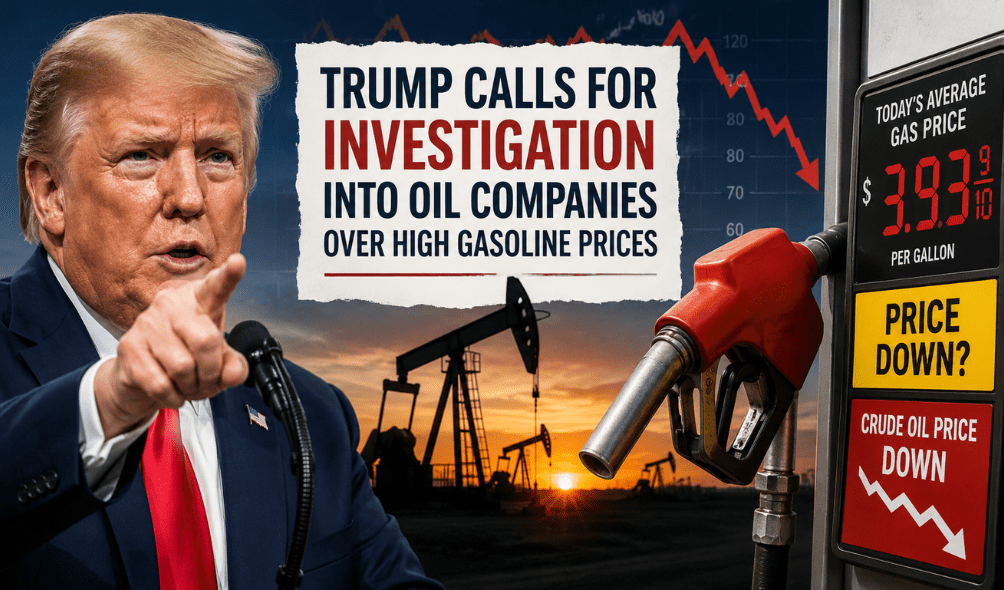
President Donald Trump has intensified his criticism of the U.S. oil industry, accusing major energy companies of failing to reduce gasoline prices in line with declining crude oil costs and calling for a federal investigation into the matter.
The president’s remarks come at a time when fuel prices remain a major concern for consumers and policymakers alike. While crude oil prices have fallen significantly from recent highs, many Americans continue to face elevated costs at the gas pump, fueling debate over whether the energy sector is passing savings on to consumers quickly enough.
Table of Contents
Trump Targets Oil Companies Over Fuel Prices
In a post shared on Truth Social, Trump argued that oil producers are benefiting from lower crude oil costs while motorists continue paying relatively high gasoline prices.
According to the president, the decline in oil prices should have translated into more substantial reductions at gas stations across the country. He claimed that consumers are being unfairly burdened and suggested that the industry is not responding appropriately to changing market conditions.
Trump stated that gasoline prices should be falling more rapidly and directed the Department of Justice (DOJ) to examine whether large oil companies are engaging in practices that are harming consumers.
Call for Immediate Federal Scrutiny
The president urged federal authorities to investigate the issue without delay, although he did not identify any specific company or provide evidence of wrongdoing by individual firms.
His comments represent another instance of direct public pressure from the White House on industries viewed as contributing to rising consumer costs.
Fuel Prices Remain a Key Political Issue
Gasoline prices continue to be one of the most visible economic concerns for American households. Changes in fuel costs often influence transportation expenses, consumer spending and broader inflation trends.
The issue has gained increased political significance as policymakers focus on the economic pressures facing voters. Rising living costs and inflation remain major topics of public debate, making fuel affordability a particularly sensitive subject.
Inflation and Consumer Concerns
Recent inflation data has highlighted the role of energy costs in overall price increases. Although crude oil prices have retreated from earlier peaks, consumers have not yet experienced proportional relief at gas stations.
This gap between falling oil prices and slower-moving gasoline prices has become a focal point of criticism from both political leaders and consumer advocates.
Oil Industry Responds to Criticism
Representatives of the energy industry pushed back against suggestions that gasoline prices should move in direct lockstep with crude oil prices.
Industry officials emphasized that fuel pricing is influenced by a range of factors beyond the cost of crude oil. Refining operations, transportation expenses, inventory levels, seasonal demand patterns and global supply disruptions all contribute to the final price consumers pay.
Market Factors Affecting Gasoline Prices
The American Petroleum Institute noted that significant disruptions in global energy markets can create delays between movements in crude oil prices and retail gasoline prices.
Industry representatives argue that refining capacity and supply chain conditions can continue to influence fuel costs even after crude prices begin to decline.
As a result, lower oil prices do not always produce immediate reductions at the pump.
Crude Oil Prices Have Fallen Significantly
Market data shows that benchmark U.S. crude oil prices have dropped considerably from highs reached earlier this year.
Prices that previously approached $120 per barrel have fallen closer to $70 per barrel, representing a substantial decline from wartime peaks triggered by geopolitical tensions in the Middle East.
At the same time, average gasoline prices have also moved lower, although not at the same pace as crude oil.
Gasoline Prices Still Above Last Year’s Levels
According to widely tracked fuel-price data, average gasoline prices have retreated from recent highs recorded over the past month.
Despite that decline, fuel prices remain noticeably higher than they were during the same period a year ago, continuing to place financial pressure on households and businesses.
Lawmakers Renew Debate Over Industry Profits
Trump’s comments reignited a broader political debate surrounding the profits earned by oil companies during periods of elevated energy prices.
Some Democratic lawmakers argued that the administration should support stronger measures aimed at limiting excessive profits generated during times of market disruption.
Supporters of additional oversight contend that consumers deserve protection from pricing practices that may unfairly increase costs during periods of economic uncertainty.
Calls for Greater Accountability
Several lawmakers have proposed policies designed to address concerns about unusually high industry earnings during energy crises.
These proposals include measures intended to capture excess profits and direct additional resources toward consumer relief efforts.
However, such initiatives remain politically contentious and continue to face opposition from industry groups and free-market advocates.
Administration Signals Continued Monitoring
Federal officials have previously indicated that they are closely monitoring pricing behavior throughout the fuel supply chain.
Administration representatives have stressed that retailers and other market participants should ensure that price decreases are passed on to consumers when market conditions improve.
The government’s broader focus remains centered on maintaining affordable energy supplies while ensuring competitive market practices.
Questions Over DOJ Action
While Trump publicly called for an investigation, the Department of Justice stopped short of confirming whether a formal probe would be launched.
A department spokesperson acknowledged the importance of affordable fuel prices for American consumers and the broader economy but did not announce any specific enforcement action.
Debate Over DOJ Independence
The president’s public request also drew attention from legal and political observers who noted that direct presidential calls for investigations have historically raised questions about the independence of federal law enforcement agencies.
Critics argue that investigative decisions should remain insulated from political influence, while supporters maintain that elected leaders have a responsibility to address consumer concerns.
Energy Experts Question Likelihood of Major Findings
Several energy analysts and former government advisers expressed skepticism that an investigation would uncover evidence of coordinated wrongdoing.
Experts pointed out that previous inquiries into gasoline pricing have frequently been launched during periods of elevated fuel costs, yet many have concluded without finding proof of collusion or anti-competitive conduct.
Historical Pattern of Price-Gouging Allegations
Analysts note that accusations of price gouging often emerge when gasoline prices remain high despite changes in crude oil markets.
Over the years, multiple investigations have examined industry practices during similar periods of public concern.
Most have determined that market dynamics rather than coordinated manipulation were primarily responsible for pricing trends.
Understanding the “Rockets and Feathers” Effect
Economists have long studied a phenomenon commonly referred to as “rockets and feathers.”
The term describes how gasoline prices often rise rapidly when crude oil becomes more expensive but decline more gradually when crude prices fall.
Why Prices Do Not Always Fall Immediately
Researchers attribute this pattern to several factors, including inventory management, supply chain adjustments, market competition and consumer purchasing behavior.
As a result, retail fuel prices frequently take longer to reflect decreases in crude oil costs than increases.
This economic principle is often cited whenever consumers question why pump prices remain elevated after oil markets begin to cool.
Retail Fuel Pricing Is Largely Localized
Industry specialists also emphasize that major oil producers generally do not directly determine the prices displayed at most gas stations.
A large portion of fuel retailers are independently owned businesses that make pricing decisions based on local competition, operating expenses and regional market conditions.
Independent Stations Play a Major Role
With thousands of independently operated fuel stations across the United States, retail gasoline prices can vary significantly from one region to another.
This decentralized pricing structure makes it difficult to attribute nationwide fuel costs solely to large oil producers.
Industry Warns of Ongoing Market Uncertainty
Energy executives continue to express concerns about volatility in global markets and the difficulty of forecasting future prices.
Recent surveys indicate that many companies view geopolitical developments and rapidly changing policy signals as major sources of uncertainty.
Executives argue that unpredictable market conditions can complicate investment planning and long-term business decisions.
Outlook for Fuel Prices Remains Uncertain
As policymakers, industry leaders and consumers continue to debate the causes of elevated gasoline prices, the future direction of energy markets remains unclear.
While crude oil prices have retreated significantly from earlier highs, experts caution that global supply conditions, geopolitical tensions, refining capacity and consumer demand will continue to influence gasoline prices in the months ahead.
Trump’s call for a federal investigation has added another dimension to the ongoing discussion, but whether such efforts result in formal action or meaningful changes in fuel pricing remains to be seen.