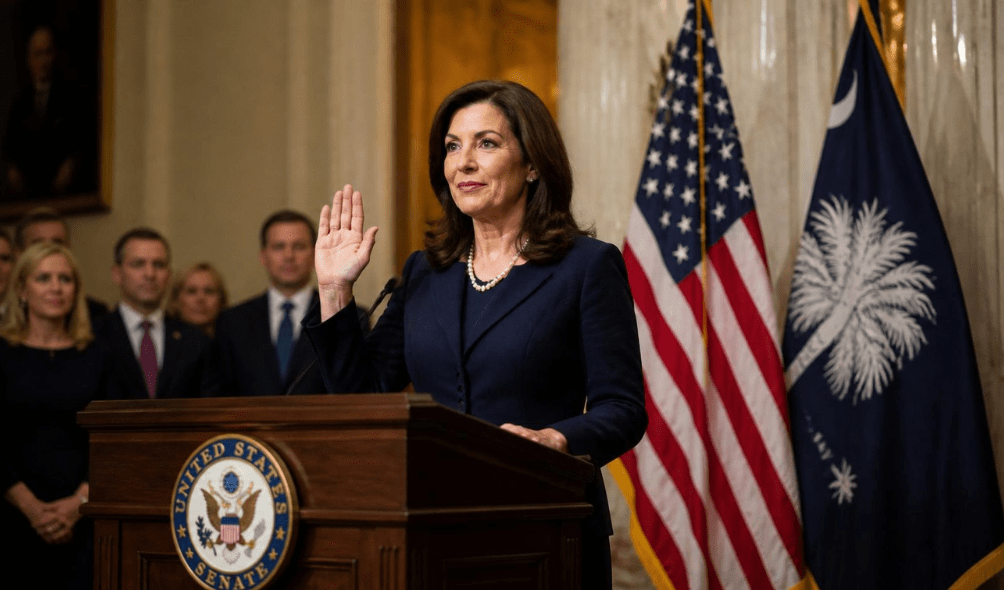
Darlene Graham Nordone spent much of her life standing just behind her brother, Senator Lindsey Graham, as he built a career at the center of Republican politics. Now, following his sudden death over the weekend at age 71, she has been asked to stand in his place.
South Carolina Governor Henry McMaster named Nordone to fill the vacant U.S. Senate seat during a press event Monday at the state capitol in Columbia. The choice reunites two siblings whose bond was forged in hardship decades earlier, when a college-aged Graham took on the responsibility of raising his younger sister after both of their parents died.
“Lindsey took care of his little sister in years long departed,” McMaster told reporters, framing the appointment as a tribute to that relationship. “It’s my honor to ask his little sister, Darlene Graham, to finish his work for him now.”
Nordone, 62, accepted the position surrounded by family and friends still mourning her brother’s passing. She described the moment as a continuation of a lifelong exchange of care between the two of them, saying that just as he had always shown up for her, she now intended to show up for him.
Table of Contents
A Childhood Shaped by Loss — and by Each Other
Long before politics entered the picture, the Graham siblings shared a modest upbringing behind their family’s business, a small café-and-bar establishment called the Sanitary Café in the town of Central, South Carolina. The two were separated by nearly ten years, but the age gap did little to loosen their connection.
Graham was the one who taught his sister basic childhood skills — including, by her own account, spelling her own name. She still spells it “Darlene” with an “I,” even though her birth certificate lists a different spelling, a quirk she traces directly back to her brother’s early instruction. He also ran alongside her bicycle as a child, coaching her to keep pedaling until she could ride on her own.
Everything changed when their parents died within roughly a year of each other, leaving 13-year-old Darlene without a guardian. Graham, then in college, stepped in immediately. He later formally adopted her, a legal step that allowed her to access the benefits tied to his service as an Air Force lawyer. Even while continuing his studies, he made a point of returning most weekends to spend time with her, according to accounts she has given in past interviews.
A Political Partnership That Spanned Decades
As Graham’s political career advanced — from his first congressional bid to his eventual Senate tenure and a run for the presidency — Nordone was rarely far from the campaign trail. She canvassed neighborhoods for his initial House campaign in 1992. Two decades later, in 2014, she appeared in a campaign advertisement recounting how he had taken responsibility for her as a teenager. When Graham launched his 2015 presidential bid outside the home where they grew up, it was Nordone who introduced him to the crowd, telling supporters that he had never failed her.
Neither sibling married or had children of their own, which meant that as tributes flowed in following Graham’s death, many extended sympathy directly to Nordone as his closest surviving relative. Their dynamic had even become something of a running line on the 2016 campaign trail: asked once who might serve as his first lady in the White House, Graham joked that his sister could fill the role if it came down to it.
That presidential run ultimately went to Donald Trump, a candidate Graham had once sharply opposed before later becoming one of his more reliable allies in the Senate and a regular golfing companion. It was Trump who publicly pushed for Nordone’s appointment ahead of McMaster’s announcement, calling her a fitting choice on social media and describing the move as a meaningful tribute to a brother who, in Trump’s words, cared deeply for her.
Taking the Oath at a Turbulent Moment
Nordone is scheduled to be sworn in Tuesday, a milestone that makes her the first woman ever to represent South Carolina in the U.S. Senate. In brief remarks following her appointment, she signaled that she views the role as an extension of her brother’s unfinished work, telling the audience she intended to spend the coming months supporting the president’s agenda and continuing efforts she believes Graham would have wanted carried forward.
She inherits the seat at a demanding time for the chamber. The Senate is currently navigating a war involving Iran that Graham had forcefully supported, along with ongoing negotiations over the National Defense Authorization Act and pressure from the White House to advance contested voting-related legislation that has yet to win broad Republican backing.
Nordone brings no prior electoral experience to the job, though she is not entirely new to public service. Since 2019, she has served as a commissioner for the South Carolina Commission for the Blind, where her work centered on expanding job opportunities and independent-living resources for residents who are blind or visually impaired. Earlier in her career, she held roles at Clemson University and within two different state agencies.
Part of a Longer Tradition of Family Appointments
Nordone’s rise to the Senate fits into a recognizable, if increasingly rare, pattern in American political history sometimes referred to as “widow’s succession” — the practice of temporarily installing a close relative, historically a spouse, in a vacated seat until voters can choose a permanent replacement. That tradition helped pave the way for greater representation of women in Congress throughout the 1900s and Nordone’s appointment follows a similar caretaker logic, even though she is a sibling rather than a spouse.
Other examples of family succession offer useful comparison points. In 2000, Missouri Governor Mel Carnahan died in a plane crash while running for the U.S. Senate, then won the election posthumously. His widow, Jean Carnahan, was appointed to hold the seat until a 2002 special election, which she went on to lose. A more contested case unfolded in Alaska in 2002, when Governor Frank Murkowski appointed his own daughter, Lisa Murkowski — then serving in the state legislature — to the Senate seat he had just vacated. She has held that seat in every election since.
Not every vacancy is filled with a relative or a seasoned political figure, however. Earlier this year, Oklahoma Governor Kevin Stitt appointed energy company executive Alan Armstrong to replace Senator Markwayne Mullin after Mullin joined the Trump administration as homeland security secretary. Armstrong, who had no prior experience in elected office, is barred under state law from seeking a full term in this year’s general election.
What Comes Next for South Carolina’s Senate Seat
At the time of his death, Graham had just secured the Republican nomination for a fifth Senate term, having won the primary only weeks earlier. His passing has already set off speculation over who will compete to hold the seat permanently in November. While Nordone has stopped short of ruling out a run of her own, those close to the process do not expect her to enter next month’s special Republican primary.
Graham himself once suggested, years before any of this became necessary, that his sister had the instincts of a natural public servant. Asked in a 2015 interview what part she might play if he won the presidency, he said he could not imagine a better person to represent the country than she would be.
For now, that instinct will be tested not in a hypothetical West Wing appointment, but on the floor of the U.S. Senate, where Darlene Graham Nordone begins her tenure this week carrying both her brother’s name and, by her own description, an intention to finish what he started.
Also Read: Paraguay President Pena Watches World Cup From Home