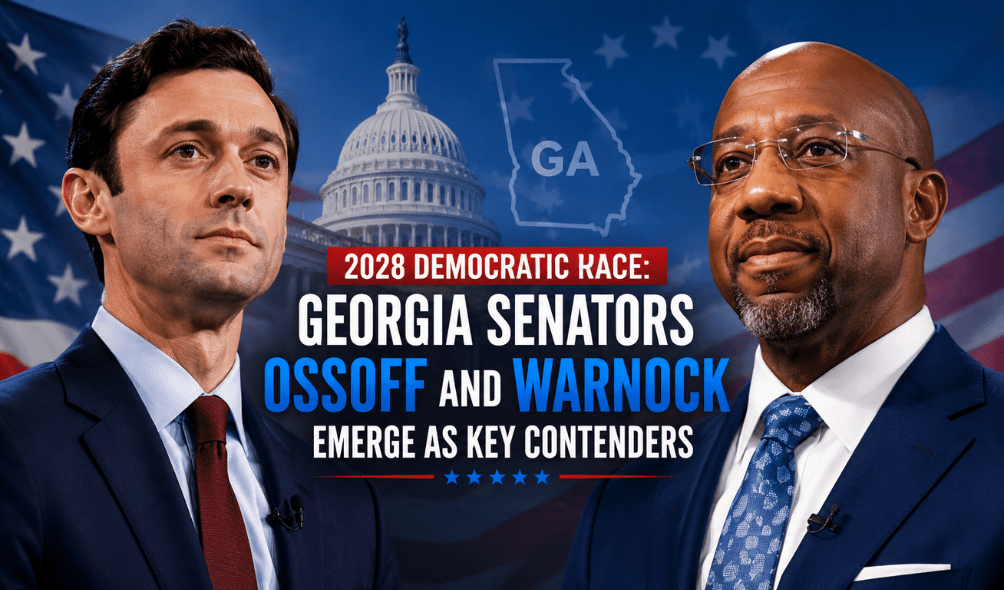
Democratic Race: As the Democratic Party gradually shifts its focus toward the 2028 presidential election, political observers are increasingly looking beyond traditional party leaders and established national figures. While the race remains years away and no clear front-runner has emerged, two names from Georgia are beginning to attract growing attention in political circles: Senator Jon Ossoff and Senator Raphael Warnock.
Both lawmakers played pivotal roles in helping Democrats secure control of the U.S. Senate during the final months of Donald Trump’s first term. Now, as discussions about the party’s future intensify, many strategists believe one of the two Georgia senators could eventually become part of the Democratic ticket in 2028.
Their appeal stems from a combination of electoral success, demographic reach, communication skills and the ability to connect with voters in a rapidly evolving political environment.
Table of Contents
Georgia’s Rising Influence in National Politics
Georgia has transformed into one of the most closely watched battleground states in American politics. Once considered a reliable Republican stronghold, the state has become increasingly competitive, reflecting broader demographic and political changes across the South.
For Democrats, maintaining strength in states such as Georgia, Arizona and North Carolina is becoming increasingly important as population growth continues to shift toward the Sun Belt region.
Why Georgia Matters for Democrats
Political strategists widely acknowledge that future Democratic presidential victories may depend on maintaining competitiveness in fast-growing southern states. While Texas and Florida remain challenging electoral targets, Georgia has demonstrated that it can support Democratic candidates under the right circumstances.
The state’s diverse electorate, growing metropolitan areas and changing voter demographics have helped make it a crucial component of the national electoral map.
Against this backdrop, both Ossoff and Warnock offer Democrats something valuable: proven statewide winners in a politically divided state.
Jon Ossoff’s Growing National Profile
At just 39 years old, Jon Ossoff represents a younger generation of Democratic leadership. His combination of political experience, media savvy and ability to communicate across ideological lines has attracted increasing attention among party activists and donors.
Although Ossoff has publicly downplayed speculation about a future presidential campaign, his political visibility has expanded significantly in recent months.
Social Media Has Amplified His Message
One of the most notable factors behind Ossoff’s rise is his effective use of digital communication.
Short-form political videos featuring the senator criticizing former President Donald Trump have generated millions of views across social media platforms. These clips frequently circulate among Democratic audiences, introducing Ossoff to voters who may have previously known little about him.
Unlike traditional campaign strategies that rely heavily on television appearances and lengthy speeches, modern political messaging increasingly depends on short, highly shareable content.
Political analysts note that Ossoff has benefited substantially from this shift.
Fundraising Success Reflects Growing Interest
The increased visibility has translated into significant fundraising success.
Ossoff has reportedly raised tens of millions of dollars for his Senate reelection campaign, placing him among the strongest fundraisers in the chamber. Strong fundraising numbers often serve as an indicator of national political interest, especially years before a presidential primary begins.
Many Democratic activists and donors have started mentioning Ossoff as a potential future presidential contender, largely due to the widespread exposure generated through digital media.
Raphael Warnock Offers a Different Kind of Leadership
While Ossoff’s rise has been closely tied to digital communication and generational appeal, Raphael Warnock brings a different set of strengths to the national stage.
The Georgia senator is widely recognized for blending faith, public service and political leadership.
As the senior pastor of Atlanta’s historic Ebenezer Baptist Church, Warnock carries a unique profile within contemporary American politics.
A Voice Rooted in Faith and Public Service
Warnock’s political identity has long been connected to his pastoral background.
Throughout his Senate career, he has emphasized practical concerns affecting Georgia families while maintaining his connection to the church where civil rights icon Martin Luther King Jr. once served.
His leadership style often combines moral reflection with policy discussions, a quality that many Democrats believe could help unify different factions within the party.
Expanding His National Presence
Warnock is also increasing his visibility beyond Georgia.
The senator is promoting a new book focused on the moral and civic dimensions of American life, providing opportunities to engage audiences across the country. His appearances in key political states and growing involvement in national Democratic events suggest an expanding role within the party.
Several prominent Democratic figures have already appeared at Ebenezer Baptist Church, further strengthening Warnock’s position as an influential voice in national political conversations.
The Strategic Value of Proven Statewide Winners
One factor that makes both Georgia senators particularly attractive to Democratic strategists is their electoral track record.
Winning statewide office in Georgia requires candidates to appeal to a broad coalition of voters, including urban, suburban and rural constituencies.
Experience Winning Competitive Elections
Warnock has already secured multiple statewide victories in highly competitive races. Ossoff, meanwhile, has also demonstrated an ability to attract support in a state where elections are often decided by narrow margins.
Their success provides evidence that they can perform effectively in politically divided environments—a skill that would be highly valuable in a national election.
Electoral Votes Could Become Critical
Georgia’s 16 electoral votes could play a decisive role in future presidential contests.
Having a nominee or vice-presidential candidate with deep roots in the state could potentially improve Democratic performance not only in Georgia but across other parts of the South as well.
As demographic trends continue to reshape the region, candidates capable of competing in Southern states may become increasingly important to the party’s national strategy.
A Contrast to Recent Political Leadership
Political analysts frequently argue that presidential elections often reflect a desire for change rather than continuity.
In that context, both Ossoff and Warnock offer a noticeably different image from recent American political leaders.
Different Styles, Shared Appeal
Ossoff projects the image of a younger, technology-aware politician comfortable navigating modern media environments.
Warnock presents himself as a thoughtful public servant whose leadership is shaped by faith, community engagement and public advocacy.
Despite their different styles, both men are known for measured communication and disciplined public messaging.
For many Democrats seeking a fresh direction after years of highly polarized politics, these qualities may prove attractive.
How Technology Is Reshaping Political Campaigns
The growing attention surrounding Ossoff and Warnock also highlights a broader transformation in political communication.
Modern campaigns increasingly depend on algorithms, social media distribution and short-form content rather than traditional news coverage alone.
The Rise of the Short-Form Video Era
Political messaging now reaches voters through mobile devices, social media feeds and video recommendations.
Supporters often encounter candidates not by actively searching for political information but because digital platforms place content directly in front of them.
This shift has changed how political reputations are built.
Ossoff’s growing popularity demonstrates how quickly a candidate can gain national recognition through viral content and consistent online engagement.
A New Model for Future Candidates
Political history has often rewarded candidates who effectively adapted to emerging communication technologies.
Television transformed presidential campaigns in the mid-20th century, while social media reshaped modern political outreach in the 21st century.
Many observers believe the next generation of candidates will need to master short-form digital communication in the same way previous leaders mastered television and traditional media.
Challenges Remain Before 2028
Despite growing speculation, significant obstacles remain before either senator can seriously be considered a presidential contender.
Ossoff must first secure reelection to the Senate, while Warnock continues balancing his political responsibilities with his role as a pastor.
Additionally, the Democratic field for 2028 is expected to be crowded, featuring governors, senators, cabinet officials and other nationally recognized figures.
The political landscape could also change dramatically over the next several years.
Looking Ahead
Although the 2028 Democratic presidential race remains in its earliest stages, Jon Ossoff and Raphael Warnock have positioned themselves as two of the party’s most intriguing emerging leaders.
Their success in Georgia, growing national visibility and ability to connect with voters through different styles of communication have elevated them beyond state politics.
Whether either senator ultimately becomes a presidential nominee, a vice-presidential candidate, or a major influence within the party’s future direction remains uncertain. However, their rising profiles suggest that Georgia’s political impact on the Democratic Party is likely to continue growing in the years ahead.
As Democrats search for leaders capable of navigating a changing electorate and a rapidly evolving media environment, both Ossoff and Warnock appear poised to remain central figures in the conversation.
Also Read: Trump Faces Growing Conservative Backlash Over Emerging Iran Agreement