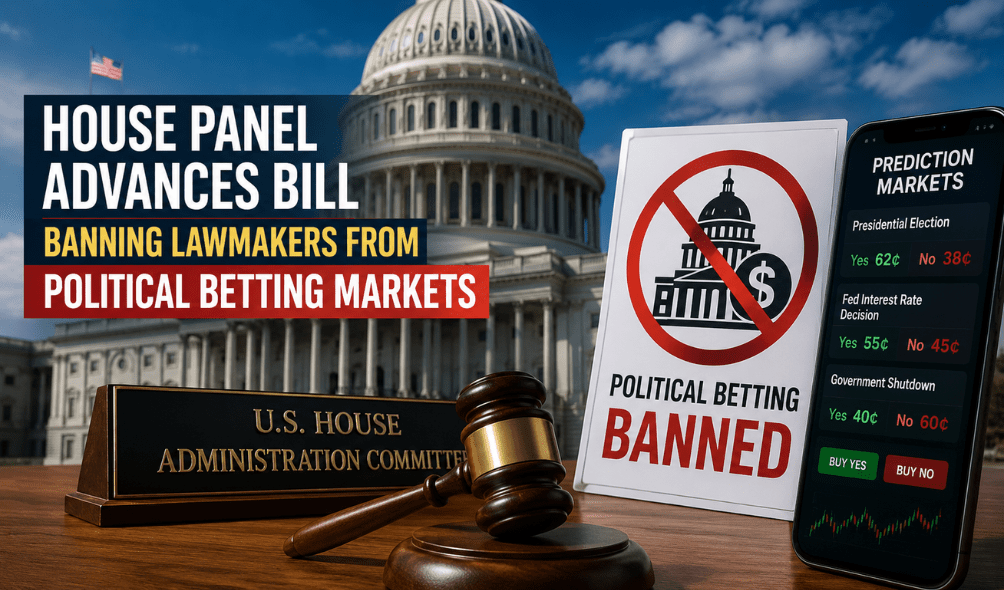
A Republican-led House committee has moved forward with legislation that would prevent members of Congress and their immediate family members from participating in certain political prediction markets, adding momentum to ongoing efforts in Washington to address ethical concerns surrounding these platforms.
The proposal, approved by Republican members of the House Administration Committee, seeks to prohibit lawmakers, their spouses and dependent children from trading on prediction markets linked to election outcomes and government actions. Supporters say the measure is designed to strengthen public confidence in Congress and reduce concerns about lawmakers benefiting from privileged information.
Table of Contents
House Committee Approves New Restrictions on Prediction Markets
The House Administration Committee advanced the legislation during a party-line vote, highlighting growing bipartisan concerns about prediction market activity while also exposing significant disagreement over how extensive the restrictions should be.
Prediction markets allow participants to buy and sell contracts tied to the likelihood of future events occurring. In recent years, these platforms have gained increased attention as they expanded beyond traditional political forecasting into broader public policy and geopolitical developments.
The proposed legislation focuses specifically on political and government-related prediction markets, targeting areas where lawmakers may have access to information that could influence trading outcomes.
Growing Scrutiny Over Insider Trading Risks
Interest in regulating prediction market participation among elected officials has intensified following several high-profile trades connected to major political and international developments.
Concerns have centered on the possibility that public officials or individuals with access to sensitive information could potentially gain an unfair advantage when participating in markets that react to government decisions, elections or geopolitical events.
As prediction markets continue to grow in popularity, ethics advocates and lawmakers have increasingly called for safeguards aimed at preventing even the appearance of conflicts of interest.
Senate Previously Adopted Broader Restrictions
The House debate comes after the Senate took a more aggressive approach earlier this year by banning senators and Senate staff members from participating in prediction market trading altogether.
That action was implemented immediately and has since become a key point of comparison in discussions surrounding the House proposal.
Critics of the House bill argue that lawmakers should follow the Senate’s example and enact a more comprehensive prohibition rather than a narrower set of restrictions focused only on certain types of markets.
Democrats Say the Proposal Does Not Go Far Enough
Democratic members of the committee opposed the legislation, arguing that it leaves too many exceptions and fails to fully address concerns surrounding prediction market activity.
Representative Joe Morelle, the committee’s ranking Democrat, criticized the measure and called for a broader ban similar to the one already adopted in the Senate.
According to Morelle, a more direct and comprehensive approach would provide stronger ethical safeguards and eliminate uncertainty about what forms of prediction market participation remain permissible.
Republicans Defend Targeted Approach
Supporters of the legislation maintain that the proposal is appropriately focused on political and public policy-related markets, which they view as the primary source of potential ethical concerns.
Representative Bryan Steil, who introduced the measure and chairs the House Administration Committee, argued that lawmakers should not be able to profit from outcomes connected to government decisions or elections.
At the same time, Steil questioned whether broader restrictions would unnecessarily impact family members participating in non-political prediction activities, including sports-related markets.
Focus on Public Trust and Accountability
Republican supporters say the legislation aims to balance ethical oversight with practical considerations by targeting markets that present the greatest risk of conflicts of interest.
They argue that elected officials are entrusted with making decisions on behalf of the public and should not have financial incentives tied to the outcomes of those decisions.
Proponents believe the measure would help reinforce accountability and strengthen confidence in congressional decision-making.
Debate Over Scope Likely to Continue
While lawmakers from both parties generally agree that ethical standards should apply to prediction market participation, disagreements remain over how broad those restrictions should be.
The House committee’s approval of the bill represents another step in Congress’s broader effort to address concerns surrounding emerging financial and forecasting platforms. However, the divide between Republicans and Democrats suggests that the debate over the appropriate limits on prediction market activity is far from settled.
As Congress continues examining the issue, lawmakers will face increasing pressure to establish rules that balance transparency, fairness and public trust while adapting to the rapidly evolving world of prediction markets.
Also Read: Tucker Carlson Says He Will No Longer Support Republican Party Ahead of Midterms