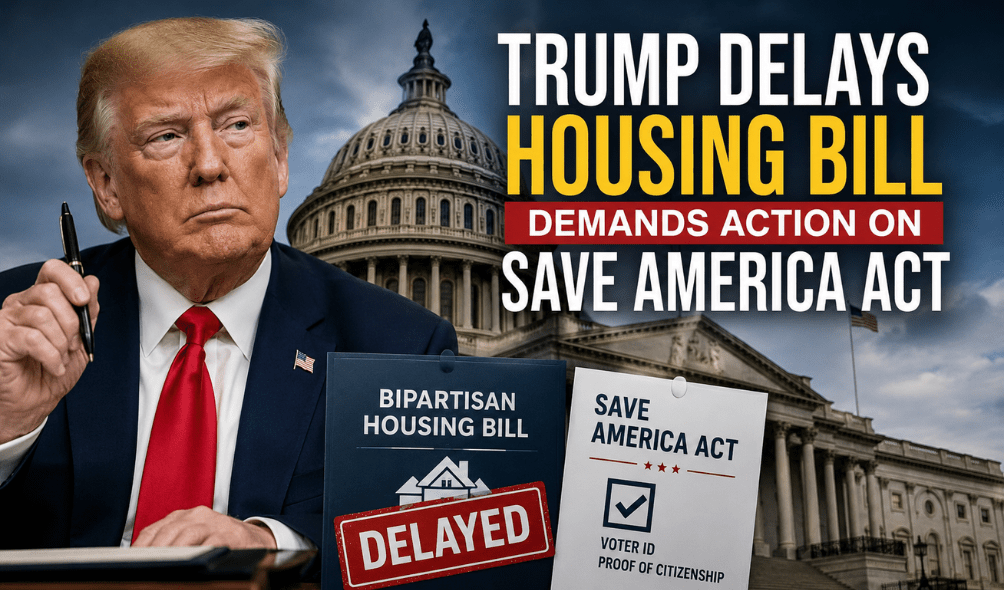
The White House had planned to highlight a significant bipartisan legislative achievement centered on housing affordability. However, those plans changed abruptly after President Donald Trump decided not to sign the housing package as scheduled, instead insisting that the Senate first advance the SAVE America Act.
The unexpected decision disrupted a carefully planned political moment that Republican leaders hoped would reinforce their message on addressing rising living costs. While the housing legislation still has a path to becoming law, Trump’s move shifted public attention toward election-related policy and exposed differing views within Republican circles over political priorities.
Table of Contents
White House Celebration Ends Before It Begins
Administration officials had spent considerable time preparing for what was expected to be a high-profile signing ceremony celebrating bipartisan cooperation on housing policy. The legislation had already cleared Congress with overwhelming support, making it one of the strongest examples of cross-party agreement in recent months.
Senior White House staff promoted the event throughout the day, expecting it to serve as evidence that the administration was taking meaningful action to improve housing affordability for American families.
Instead, the president announced that he would postpone signing the legislation until the Senate approved the SAVE America Act, a proposal he considers essential to strengthening election integrity.
The last-minute reversal surprised administration officials, congressional allies and outside Republican strategists who had anticipated a positive news cycle centered on domestic economic issues.
Bipartisan Housing Bill Received Broad Congressional Support
The housing legislation advanced comfortably through both chambers of Congress, demonstrating rare bipartisan cooperation.
Key Housing Measure Targets Affordability
Among the bill’s most notable provisions is a proposal designed to reduce housing costs by preventing institutional investors from purchasing single-family homes. Supporters argue that limiting large-scale investor activity could increase opportunities for individual homebuyers and improve affordability in competitive housing markets.
The proposal had previously been highlighted by President Trump during his State of the Union address as part of broader efforts to address housing challenges.
White House legislative officials reportedly spent weeks coordinating negotiations between House and Senate lawmakers to reconcile differences before securing final approval.
Trump Prioritizes the SAVE America Act
Rather than focusing on the housing package, President Trump placed renewed emphasis on the SAVE America Act.
The legislation includes requirements for voter identification and documentary proof of U.S. citizenship during voter registration, measures Trump and his supporters argue are necessary to protect election integrity.
Speaking after meeting Senate Republicans, the president indicated he was unwilling to compromise on including the voting legislation among broader congressional priorities.
His position effectively tied progress on the housing bill to separate election-related legislation, creating uncertainty over the timing of the bill’s formal enactment.
Political Timing Raises Questions
The decision comes as the administration seeks to redirect national attention from foreign policy debates toward domestic accomplishments.
Republican leaders have increasingly emphasized economic issues, particularly inflation, housing affordability and tax policy, as they prepare for upcoming elections. The housing bill was widely viewed as an opportunity to demonstrate bipartisan problem-solving on one of voters’ top concerns.
Instead, attention quickly shifted back to disagreements over election legislation and negotiations with Senate Republicans.
Several political observers argued that the administration missed an opportunity to reinforce its economic message during a period when affordability remains a major issue for many American households.
Mixed Reactions Within Republican Circles
The president’s decision generated differing responses among Republican allies.
Some supporters defended the strategy, arguing that Trump was using his political leverage to pressure the Senate into advancing legislation he considers fundamental to election security.
Others expressed concern that delaying the housing package weakened what could have been an effective political message centered on lowering housing costs.
Political strategists noted that the bipartisan nature of the housing legislation offered Republicans a chance to showcase cooperation and tangible policy achievements ahead of future election campaigns.
Senate Discussions Produce Little Progress
Trump’s visit to Capitol Hill included meetings with Senate Republicans, but discussions reportedly produced no significant breakthrough regarding the SAVE America Act.
The president maintained that he was unwilling to compromise on the legislation, reinforcing his commitment to making election reform a legislative priority.
Despite ongoing conversations, no immediate agreement emerged that would satisfy both the White House and Senate leadership.
Supporters Rally Behind Trump’s Position
Several prominent Trump supporters publicly endorsed the president’s decision following the announcement.
Conservative commentators and influential MAGA figures urged Senate Republicans to move forward with the SAVE America Act, arguing that election integrity should remain a top legislative objective.
Their support reflected broader backing within Trump’s political base for prioritizing voting reforms, even if doing so temporarily delayed other legislative victories.
Housing Bill Still Likely to Become Law
Although the planned signing ceremony was canceled, the legislation has not been abandoned.
Constitutional procedures allow certain bills to become law even without a presidential signature if they remain unsigned after being formally presented to the president for the required period, provided no veto is issued.
According to individuals familiar with the legislative process, House Republican leadership had not yet officially delivered the measure to the president at the time of the announcement, meaning the timeline for final enactment had not yet begun.
As a result, the housing legislation could still take effect even if Trump ultimately decides not to sign it.
Political Opportunity Gives Way to Fresh Uncertainty
The canceled signing ceremony represents more than a scheduling change. It highlights the ongoing balancing act between advancing policy initiatives and pursuing broader political objectives.
For Republican leaders hoping to emphasize affordability and cost-of-living issues, the housing package offered a chance to demonstrate bipartisan legislative success. Instead, debate shifted toward election reform and internal party strategy.
Whether the housing bill eventually becomes law through presidential approval or constitutional procedure, the political narrative surrounding the legislation has already changed.
Rather than celebrating a bipartisan accomplishment on housing affordability, Washington’s attention is now focused on how Trump’s insistence on advancing the SAVE America Act could shape both legislative negotiations and the Republican Party’s broader political messaging in the months ahead.
Also Read: House Republicans Advance Bill to Ban Lawmakers From Political Prediction Markets