Democratic Party’s Israel Divide Laid Bare as 103 House Members Back Aid Cutoff
A Symbolic Vote Exposes a Real Rift
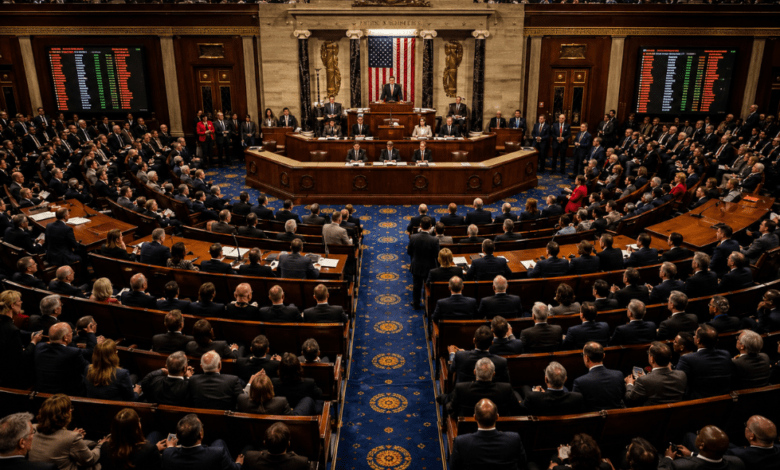
A vote that was never expected to pass has still managed to reveal something significant about the state of the Democratic Party. On Wednesday, the House of Representatives rejected an amendment that would have stripped $3.3 billion in military financing for Israel from the fiscal year 2027 State Department appropriations bill. The measure failed by a wide margin, 104 to 314, with 10 members voting present, but the breakdown of that vote told a more complicated story than the final tally suggests.
Nearly half of the House Democratic Caucus — 103 lawmakers — voted to advance the aid cutoff, while 98 of their colleagues voted no and 10 chose to register a present vote rather than take a firm position. The near-even split stands in sharp contrast to the amendment’s sole Republican supporter: its author, Rep. Thomas Massie of Kentucky, was the only member of his party to vote for his own proposal.
Table of Contents
What the Amendment Would Have Done
The proposal, attached to the State Department and national security funding bill, sought to bar the bill’s funds from being directed to Israel and to cut $3.3 billion from the Foreign Military Financing Program — an amount equivalent to what had been earmarked for Israel in the underlying legislation. Massie’s effort was widely viewed on Capitol Hill as a long-shot protest vote rather than a serious legislative threat, but it nonetheless forced Democrats to publicly stake out positions on an issue that has grown increasingly divisive within the party’s ranks.
Leadership Splits Down the Middle
The vote exposed daylight among the party’s most senior figures. House Minority Leader Hakeem Jeffries of New York and Democratic Caucus Chair Pete Aguilar of California both opposed the amendment, while House Democratic Whip Katherine Clark of Massachusetts broke with them to support it. Former House Speaker Nancy Pelosi of California also voted in favor.
In a Dear Colleague letter circulated ahead of the vote, Jeffries laid out his reasoning for opposing the measure, describing it as sweeping enough to also affect humanitarian assistance, refugee resettlement programs, peace-building initiatives and the operations of U.S. embassies — consequences he argued went well beyond its stated target. He characterized the effort as a politically motivated maneuver by Republicans rather than a genuine policy solution, adding that more effective approaches exist to pressure the current Israeli government led by Prime Minister Benjamin Netanyahu.
Clark, despite reaching a different conclusion on how to vote, largely agreed with Jeffries’ criticism of the amendment’s scope. She said in a statement that she viewed it as overly broad and acknowledged that Republicans were using it to score political points. Still, she argued that continuing on the current path was no longer acceptable, saying military assistance should not be extended unconditionally to any nation that fails to meet standards set by U.S. law and values — and that, in her assessment, the Netanyahu government had fallen short of that bar. She framed her yes vote as a statement about the need to change direction, not an endorsement of the amendment’s specific terms or the motives behind it.
Pelosi struck a similar note in her own statement. She reaffirmed her longstanding support for a strong U.S.-Israel relationship and a two-state solution, while acknowledging the amendment placed the House in a difficult position. She argued that a shift in American policy was necessary to achieve lasting peace for both Israelis and Palestinians and said the public was increasingly weary of continuous conflict in the region. While calling the amendment poorly designed, she said her yes vote was meant to send a message that the status quo could not continue.
The Ten Who Chose Present
Ten Democrats opted not to cast a yes-or-no vote at all, instead voting present. That group included Reps. Ami Bera of California, Shontel Brown of Ohio, Janelle Bynum of Oregon, Sarah Elfreth of Maryland, Jared Huffman of California, Betty McCollum of Minnesota, Kelly Morrison of Minnesota, Chris Pappas of New Hampshire, Linda Sánchez of California and Mike Thompson of California. Their decision to sidestep a definitive position reflects just how politically fraught the issue has become for members representing a range of districts and constituencies.
A Preview of Bigger Fights Ahead
While the amendment’s defeat was never in doubt, the vote count offers a clearer picture of where the Democratic Party currently stands on Israel policy than any single leadership statement could. With activist pressure continuing to build within the party’s base and figures as senior as a former Speaker and the sitting Whip breaking from the top two elected leaders in the House, the debate over U.S. support for Israel appears likely to keep resurfacing — including potentially in future spending bills, primary contests and the party’s broader 2028 positioning.