Senate Republicans Seek Greater Oversight of Trump’s Emerging Iran Deal Amid Calls for Transparency
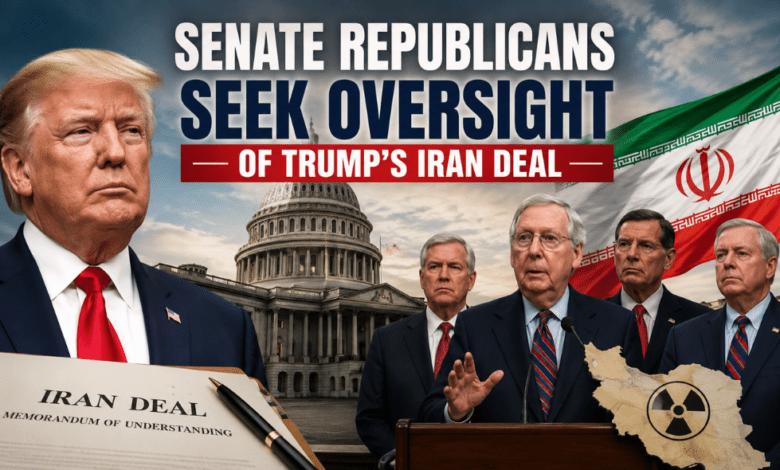
President Donald Trump’s administration is promoting a proposed agreement with Iran as a major diplomatic breakthrough that could bring an end to months of conflict and reduce economic uncertainty. However, despite support for efforts to de-escalate tensions in the Middle East, many Republican lawmakers are signaling that they want a closer look at the details before fully embracing the deal.
The emerging agreement has sparked intense discussion on Capitol Hill, where lawmakers from both parties are seeking answers about its provisions, particularly regarding Iran’s nuclear activities and the role Congress may play in reviewing any final arrangement.
Table of Contents
Lawmakers Await Details of the Iran Memorandum
Questions surrounding the agreement intensified after reports indicated that Vice President JD Vance signed a memorandum of understanding with Iranian officials. Yet, as of Monday, the text of the document had not been publicly released, leaving senators with limited information about its specific commitments and enforcement mechanisms.
The absence of publicly available details has created uncertainty among lawmakers who argue that Congress must have sufficient time to evaluate the agreement before it becomes a lasting component of U.S. foreign policy.
Several senators emphasized that transparency will be essential if the administration hopes to build broad political support for the arrangement.
Republicans Stress Importance of Congressional Approval
Many Republican lawmakers believe that any significant agreement involving Iran’s nuclear program should extend beyond executive authority and receive formal congressional consideration.
Senators argued that long-term stability requires bipartisan backing and legislative support, especially when dealing with a geopolitical issue as consequential as Iran’s nuclear ambitions.
Some lawmakers noted that agreements lacking congressional approval often become vulnerable to reversal by future administrations, creating uncertainty for both allies and adversaries.
Comparisons to the 2015 Iran Nuclear Agreement Resurface
The proposed agreement has inevitably revived memories of the 2015 nuclear accord negotiated during former President Barack Obama’s administration.
That agreement, formally known as the Joint Comprehensive Plan of Action (JCPOA), generated fierce debate in Washington. Supporters viewed it as a mechanism to restrict Iran’s nuclear development, while critics argued that it provided Tehran with significant economic benefits in exchange for temporary restrictions.
Trump withdrew the United States from the JCPOA during his first term, citing concerns that the deal failed to adequately address Iran’s long-term nuclear capabilities and regional influence.
Now, lawmakers across the political spectrum are assessing whether the new agreement represents a substantial departure from the previous framework or simply a revised version of it.
Concerns Focus on Uranium Enrichment
One of the most significant issues under discussion is Iran’s ability to enrich uranium.
Several Republican senators have indicated that their assessment of the agreement will largely depend on whether Iran is permitted to continue enrichment activities. Critics of the original JCPOA have long argued that allowing any enrichment capability leaves open a pathway for future nuclear weapons development.
Supporters of stricter restrictions contend that a successful agreement should include clear safeguards preventing Iran from advancing toward a nuclear weapons program.
At the same time, lawmakers acknowledge that negotiations involving nuclear issues are often complex and require balancing security concerns with diplomatic realities.
Administration Promises Additional Information
The Trump administration has indicated that the memorandum of understanding is expected to be released publicly in the coming days.
Officials have defended the agreement as a major diplomatic achievement, emphasizing that it is designed to prevent Iran from acquiring a nuclear weapon while also contributing to regional stability.
According to information shared with Republican lawmakers, the administration believes the agreement delivers stronger outcomes than previous diplomatic efforts and could help ease pressure on global energy markets.
White House Highlights Security and Economic Benefits
Administration officials have emphasized several key objectives of the agreement.
Among the primary claims being promoted are assurances that Iran will not obtain a nuclear weapon and that reduced regional tensions could contribute to lower energy prices.
The administration also argues that successful diplomacy could provide broader economic benefits by improving market confidence and reducing disruptions to global trade routes.
One area receiving particular attention is the Strait of Hormuz, a strategically important shipping corridor that plays a critical role in global energy transportation.
Congressional Review Process Could Shape the Deal’s Future
While lawmakers expect Congress to play some role in reviewing the agreement, questions remain about the extent of that involvement.
A law passed in 2015 provides Congress with an opportunity to examine agreements related to Iran’s nuclear program. However, the legislation does not require lawmakers to approve such agreements before they take effect.
Instead, Congress has the ability to pass a resolution of disapproval. Such a measure could face a presidential veto, meaning opponents would likely need substantial bipartisan support to block the agreement.
Senate Leaders Seek Briefings
Senate leaders have indicated that lawmakers need significantly more information before reaching conclusions about the proposal.
Many members acknowledged that even senators who closely follow foreign policy developments currently possess only limited knowledge about the agreement’s specifics.
As a result, expectations are growing that senior administration officials will provide classified and public briefings to Congress in the near future.
Several senators also expressed frustration that lawmakers are being asked to react to reports about the agreement before reviewing its actual language.
Republican Reactions Range from Optimism to Skepticism
Although questions remain, many Republicans support efforts to end the conflict and avoid prolonged instability in the Middle East.
Some lawmakers have publicly expressed optimism after discussions with White House officials, suggesting that diplomacy offers an opportunity to strengthen regional security while reducing economic uncertainty at home.
Others have adopted a more cautious approach, arguing that support will ultimately depend on the final terms of the agreement and the strength of its enforcement provisions.
Debate Over Treaty Requirements Continues
Not all Republicans believe Congress will ultimately cast a direct vote on the agreement.
Some lawmakers predict that the administration could structure the arrangement in a manner that avoids formal treaty requirements, a strategy that has been used in previous international agreements.
This possibility has fueled additional debate over how major foreign policy commitments should be handled and whether Congress should play a larger role in shaping them.
Democrats Wait for Full Details Before Taking a Position
Democratic lawmakers have also refrained from making definitive judgments while waiting for additional information.
Some Democrats may find themselves in a complicated political position if the agreement resembles elements of the 2015 nuclear accord that many in the party previously supported.
Others have questioned whether the recent conflict was necessary and what tangible benefits emerged from the confrontation.
Despite these concerns, Democratic leaders agree with Republicans on one point: the public deserves greater transparency regarding the contents of the agreement.
Calls for Accountability and Transparency Grow
As debate intensifies, lawmakers from both parties are emphasizing the importance of transparency and oversight.
Members of Congress argue that any agreement involving Iran’s nuclear program carries significant implications for national security, international diplomacy and global economic stability.
For that reason, many senators believe the administration must release the full text of the agreement and provide lawmakers with sufficient opportunities to evaluate its provisions before any long-term commitments are finalized.
What Comes Next?
The coming days are expected to be critical for the future of the proposed Iran agreement.
Once the memorandum of understanding becomes public, lawmakers will begin examining its provisions in detail, including restrictions on Iran’s nuclear activities, enforcement measures and compliance mechanisms.
Congressional briefings, public debate and potential review procedures could determine whether the agreement gains broad bipartisan support or becomes another chapter in the long-running political battle over U.S. policy toward Iran.
Until then, both supporters and critics are united in one demand: greater clarity about what the agreement contains and how it will shape America’s relationship with Iran in the years ahead.
Also Read: Kennedy Center Keeps Exterior Covered After Trump Name Removal Amid Ongoing Legal Battle