Fuel Anxiety and Global Shifts – Why Indians are Flocking to EVs
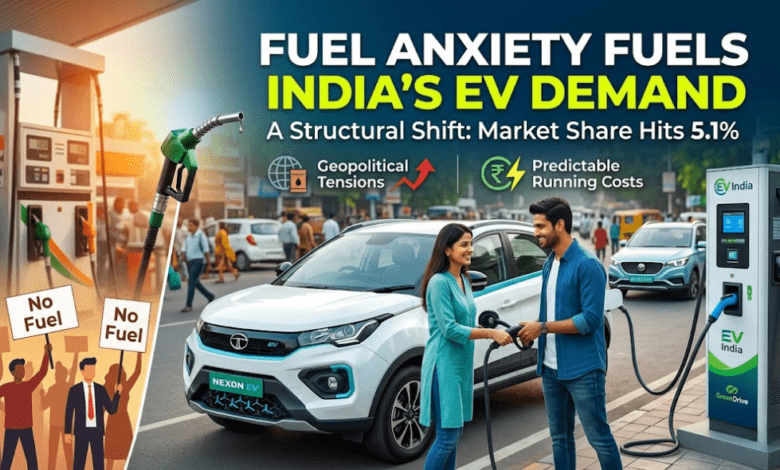
For years, the conversation around electric cars in India felt like a distant “someday” goal, a mix of environmental idealism and high-tech curiosity. But walk into any major car showroom today, and the atmosphere has shifted. It’s no longer just about saving the planet; it’s about a very human need for stability in an increasingly unpredictable world.
As global headlines flicker with news of the US-Israel-Iran conflict, the anxiety over fuel price hikes and availability is hitting home, turning EV demand from a niche trend into a mainstream movement.
Table of Contents
A Record-Breaking March for Indian Roads
The numbers tell a story of a nation reaching a tipping point. In just one month, the market share for electric vehicles jumped from 3.5% in February to a record 5.1% in March. According to the Federation of Automobile Dealers Associations (FADA), over 22,000 new electric cars were registered in that window, a massive 68% increase compared to last year.
What we are seeing isn’t just a spike in sales; it’s a shift in the Indian consumer’s mindset. People aren’t just browsing; they are buying with a sense of urgency.
The “Strait of Hormuz” Effect on the Indian Commuter
While the conflict in West Asia might feel worlds away, the geography of energy connects us all. The Strait of Hormuz handles about a fifth of the world’s oil and gas, and any disruption there sends ripples all the way to Indian petrol pumps.
Why Now? The Post-Election Fear
There is a unique local factor at play as well. Many Indian families are keenly aware that fuel prices often stay “frozen” during election cycles, only to climb once the ballots are counted. This anticipation of a post-election price hike has pushed many “fence-sitters” to finally pull the trigger on an electric car, boosting EV demand as a way to lock in predictable monthly expenses.
From the Showroom Floor – A New Kind of Buyer
Industry leaders are noticing that the typical customer profile is changing. Shailesh Chandra of Tata Motors recently pointed out that nearly a third of their new interest is coming from people specifically worried about the West Asia crisis and its impact on the cost of living.
Also Read: 6 Tips for Safe and Smooth Driving
A Decision Driven by Common Sense
Anurag Mehrotra of JSW MG Motor India observes that customers are now walking into showrooms with an electric car as their first choice. For these families, an EV isn’t a luxury gadget anymore; it’s a hedge against inflation. They are looking for:
- Price Insulation: Freedom from the daily fluctuation of global oil markets.
- Low Maintenance: The simplicity of electric drivetrains compared to complex combustion engines.
- Future-Proofing: Ensuring their vehicle remains relevant as cities expand charging networks.
This surge in EV demand is pushing manufacturers to work harder, accelerating the rollout of charging stations and focusing on localising parts to keep prices down.
A Global Shift with a Local Heart (EVs)
India’s move toward electrification mirrors a larger global pattern. From the streets of London to the highways of California, high gasoline prices are forcing a rethink of how we move. However, in India, the shift feels more personal. It’s about the middle-class family trying to protect their budget and the daily commuter looking for a smoother, quieter, and more reliable way to get to work.
Ultimately, the record-high EV demand we are seeing today is proof that when the world gets volatile, we look for solutions that put the power back in our own hands, literally. Moving to electric is becoming less about the “car of the future” and more about the common-sense choice for today.