Half of School Board Candidates Skip Political Affiliation Despite New Law
Indiana’s school board elections are looking different this year and the numbers show a state still divided on whether party labels belong in local education races.
Table of Contents
A New Ballot Rule Takes Effect
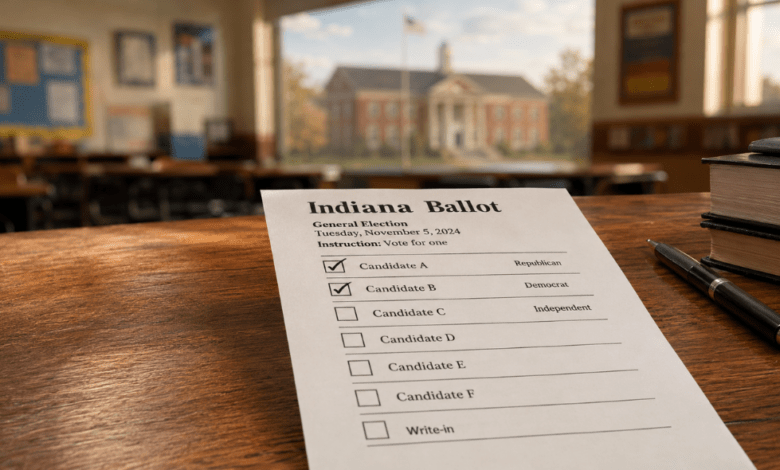
Starting with the November general election, Indiana school board hopefuls have an option they’ve never had before: they can attach a Republican, Democrat, or Independent label to their name on the ballot — or they can simply leave that space empty. The option comes courtesy of legislation signed into law in 2025 and this fall marks the first time voters will see it in action.
Out of 1,042 people seeking one of 805 open school board seats statewide, roughly half have opted to publicly declare where they stand politically. The other half are choosing to appear on the ballot without any party marker at all, a split that suggests candidates themselves are far from unified on whether the new rule is useful.
One Candidate’s Reasoning for Going Independent
Komal Kaur, a first-time candidate seeking a seat on the Franklin Township School Board, decided early on that she wouldn’t leave her ballot line blank. She’s running under the Independent label, a choice she says reflects how she wants to be seen by voters.
Kaur said she associates the Independent designation with being responsive to her community and putting students first, rather than following a party line. She added that she didn’t want voters guessing about her stance, explaining that labeling herself as Independent removes any ambiguity about her lack of allegiance to either major party. For Kaur, the designation is less about politics and more about signaling whose interests she’s representing — the people in her district, not a party platform.
The Law’s Author Says It’s About Transparency
State Senator Gary Byrne, a Republican who spent eight years as a school board member himself before entering the legislature, wrote the bill that made this option possible. He frames it as a transparency measure, arguing that a party label gives voters at least a rough sense of a candidate’s general outlook before they even read a campaign flyer.
Byrne also offered his own theory about the candidates who chose not to declare. Given that Indiana leans heavily Republican, he suspects many of those who skipped the party label may actually be Democrats hesitant to advertise it. He was careful to note this is speculation on his part rather than confirmed data, but it’s a theory that highlights how the new system could end up revealing political leanings by omission rather than declaration.
School Board Association Sees a Different Pattern
Terry Spradlin, who leads the Indiana School Board Association, offered a somewhat different read on the blank ballots, particularly in rural parts of the state. He noted that many association members are incumbent Republicans and yet a good number of them still chose not to list a party affiliation.
According to Spradlin, this isn’t necessarily about hiding political leanings — it’s about how these board members see their job. Many simply don’t view party identity as central to their approach on the board and it isn’t what drives their decision-making once they’re in office. That distinction matters: a candidate skipping the label isn’t automatically avoiding scrutiny, they may just see school governance as separate from partisan politics altogether.
Why Voters Should Still Do Their Homework
Despite the new labels appearing on ballots this fall, Spradlin was direct in cautioning that a party tag next to a candidate’s name shouldn’t replace actual research. He emphasized that voters still carry the responsibility to look into who they’re supporting, regardless of whether a Republican, Democrat, or Independent marker appears beside a name.
That advice may carry extra weight this year, given that half the candidates aren’t offering voters a party clue at all. School board races have traditionally functioned as nonpartisan contests focused on local education policy and this year’s mixed results — some candidates leaning into party identity, others opting out entirely — suggest Indiana’s experiment with political affiliation despite new law requirements is still finding its footing with both candidates and voters.
What Comes Next
With Election Day approaching, Kaur and hundreds of other candidates across Indiana will find out whether their choice to declare — or not declare — a party affiliation shaped how voters responded. Whether the change increases voter engagement or simply adds a new variable to school board races that were once purely local in focus remains an open question heading into November.
Also Read: U.S. Attorney Sues Trump Admin After 54-Minute Tenure