The Future of Voting Rights – Impact of the 2026 Supreme Court Decision
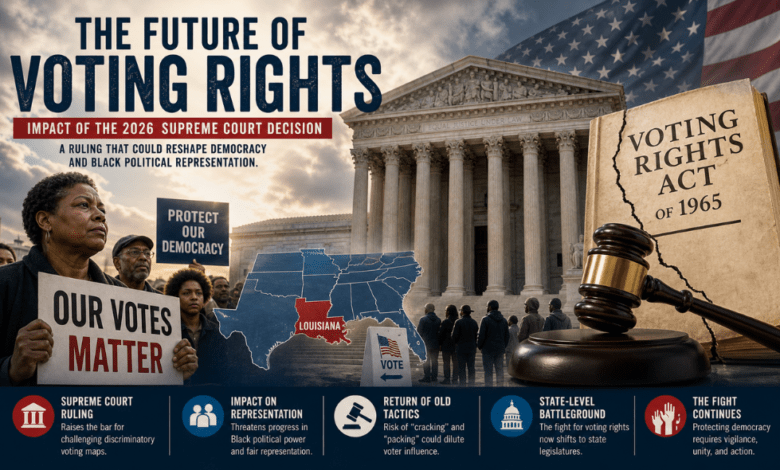
For Martha Davis, a retired teacher from North Baton Rouge, the news from Washington didn’t feel like a legal technicality, it felt like a door being slammed shut. After four decades in the classroom, Martha knew the value of having a seat at the table. When Cleo Fields was elected in 2025 to represent Louisiana’s first majority-Black district in years, she finally felt that her community’s struggles with healthcare and infrastructure were being seen.
But that sense of progress vanished this week. A 6-3 Supreme Court decision has struck down the very map that gave Martha’s community a voice, leaving thousands of voters wondering if their participation in the democratic process still carries the same weight.
Table of Contents
A Ripple Effect Across the South
The impact of this ruling reaches far beyond the bayous of Louisiana. For millions of Black Americans living in the South, the Voting Rights Act has long been the primary shield against political isolation. Now, with the court labeling the previous maps “unconstitutional,” a wave of redistricting is expected to sweep through Republican-led legislatures.
Advocates like Kristen Clarke of the NAACP describe the decision as a “death knell” for the country’s most vital civil rights law. The concern isn’t just about partisan politics; it’s about the “complexion of leadership.” When districts are redrawn, the specific needs of minority communities—from local school funding to urban development—often fall through the cracks of new, broader boundaries.
The Barrier to Being Heard
As Cleo Fields noted, the “practical effect” of this change is that it makes it nearly impossible for minority communities to challenge unfair maps. Without these protected districts, candidates who truly understand the lived experiences of these neighborhoods rarely find a path to office, leaving a massive gap in representation.
Shifting the Burden of Proof
The legal heart of the matter lies in Section 2 of the Voting Rights Act. In the past, if a map resulted in the dilution of a group’s voting power, it could be challenged. However, Justice Samuel Alito’s majority opinion has fundamentally shifted the rules of the game.
The court now requires plaintiffs to prove intentional discrimination based on current conditions. To the conservative majority, this is a necessary step to prevent the law from being “exploited” for political gain. They argue that the Constitution must be colorblind, even if the history of the districts themselves is not.
A Legacy Under Review
This shift is part of a long-term vision held by Chief Justice John Roberts, who has often argued that the “exceptional conditions” that justified the original 1965 Act are no longer present. By raising the bar for what counts as discrimination, the court is essentially saying that the era of federal oversight is drawing to a close.
Justice Kagan’s Warning: The “Demolition” of Democracy
The dissent, led by Justice Elena Kagan, did not hold back. In a powerful rebuke, she described the ruling as the “latest chapter” in a systematic dismantling of the Voting Rights Act. Her primary fear is that by requiring proof of “intent,” the court has made the law a “dead letter.”
Cracking and Packing: The Return of Old Tactics
Kagan warned that without federal guardrails, legislatures will return to “cracking and packing” the two most common ways to silence a community’s influence.
- Cracking: Spreading a specific group of voters across so many districts that they can never form a majority.
- Packing: Cramming as many voters of one group as possible into a single district to ensure they have no influence anywhere else.
For voters in segregated areas, these tactics can effectively erase their influence on the national stage, making their votes feel like a foregone conclusion rather than a choice.
A Generation of One-Party Control?
The stakes for the U.S. House of Representatives are monumental. Analysis from groups like Black Voters Matter suggests that as many as 33 districts could be targeted for mid-cycle redrawing. If these districts shift, it could cement one-party control for a generation.
This isn’t just a concern for Congress. As Janai Nelson of the NAACP Legal Defense Fund pointed out, this ruling trickles down to the most local levels of government. School boards, city councils and water boards, the people who make decisions about your daily life will all be impacted by how these lines are drawn.
Also Read: Supreme Court Voting Rights Ruling Sparks Hope, Fear and Political Divide in the US
The Fight Moves to the States
While the federal Voting Rights Act may have been weakened, the spirit of the law is finding a second life at the state level. Advocates are no longer waiting for Washington; they are pushing for “State VRAs” across the country.
- States Leading the Way: California, New York and Virginia have already built their own firewalls to protect voters.
- The New Frontier: In places like Mississippi and Louisiana, activists are working to pass local laws that mirror the original federal protections.
For citizens like Ambrose Sims, who lived through the era of segregation, the ruling is a “call to order.” He believes that while the court may have changed the rules, it has only strengthened the resolve of the people. The fight for the ballot box is far from over; it’s simply entering a more local, more personal chapter.