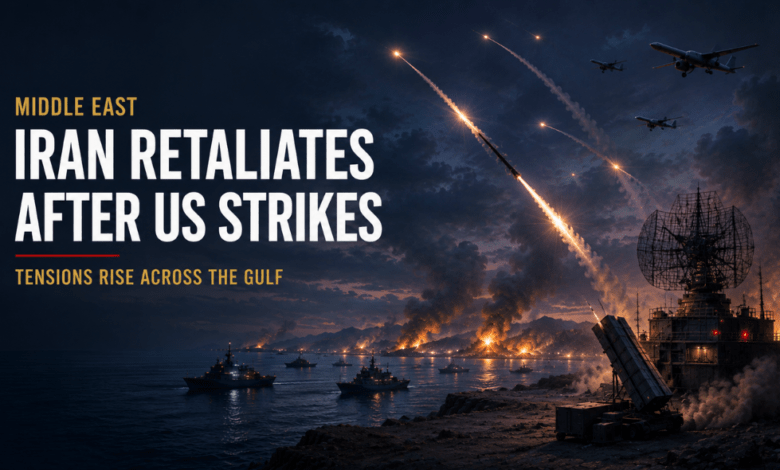
The Middle East witnessed another major escalation after Iran retaliates after US strikes with missile and drone attacks aimed at American military assets across the Gulf region. The latest exchange followed a new round of United States military operations inside Iran which targeted strategic military infrastructure linked to the Islamic Revolutionary Guard Corps.
The renewed conflict has increased fears of a broader regional confrontation while raising concerns over global energy security and maritime safety in the Strait of Hormuz. Oil prices climbed sharply and neighboring countries activated air defense systems as the violence spread beyond Iran’s borders.
Table of Contents
Fresh military escalation follows weeks of relative calm
The latest crisis began after the United States launched additional airstrikes on Tuesday against several military locations inside Iran. According to US Central Command the operation focused on radar installations air defense systems communications facilities maritime assets and mine laying capabilities associated with the IRGC.
American officials said the strikes were carried out in response to recent Iranian attempts to threaten commercial shipping and US military personnel operating near the Strait of Hormuz. The operation reportedly lasted for more than six hours before military commanders declared it complete.
Soon afterward President Donald Trump warned Tehran against responding militarily. He stated that any retaliation would trigger an even stronger American response and suggested that larger military options remained available if the conflict continued.
Despite that warning Iran retaliates after US strikes by launching ballistic missiles toward Jordan and sending drones toward Bahrain and Kuwait. Iranian officials said the attacks were directed at US military facilities rather than civilian targets.
Iran launches missiles and drones across the region
Jordan confirmed that its armed forces intercepted ten incoming ballistic missiles while several additional projectiles landed in remote desert areas away from populated communities. Authorities reported no deaths or injuries from the missile barrage.
Bahrain and Kuwait also activated their air defense systems after detecting Iranian drones approaching their airspace. Officials in both countries said the unmanned aircraft were successfully intercepted before reaching their intended destinations.
Iran also announced a combined missile and drone operation targeting military objectives near Erbil in Iraq’s Kurdistan region. While Tehran described the strikes as defensive retaliation regional authorities continued assessing damage and security conditions.
The expanding battlefield demonstrated how Iran retaliates after US strikes had immediate consequences for several countries hosting American military bases throughout the Gulf.
United States says military targets were the objective
US Central Command maintained that every target selected during Tuesday’s operation had military significance. Officials said the objective was to reduce Iran’s ability to threaten international shipping and regional security through radar coverage naval operations and mine deployment.
American military spokesperson Captain Timothy Hawkins rejected accusations that civilians had been deliberately targeted. He stated that the US military does not conduct operations against civilian populations and attributed the allegations to Iranian state media reporting.
The Pentagon has not released detailed battle damage assessments though officials indicated that strategic military infrastructure suffered significant disruption during the strikes.
Iran reports civilian casualties after wedding tragedy
A major humanitarian controversy emerged after Iranian authorities claimed that debris from one of the American strikes struck a building hosting a wedding celebration in the coastal village of Kouhestak located in Sirik County.
According to Iranian state media at least four people lost their lives including a four year old child while another sixty eight people were injured. Regional health officials said many of the wounded were children under the age of ten who had been attending the celebration with their families.
Videos circulated by Iranian media appeared to show damaged homes thick smoke and rescue efforts inside the village. Independent verification of the incident remains limited and international media organizations including CNN said they were unable to confirm the details of the alleged strike.
The civilian casualty claims quickly became a central issue in Iran’s public response as officials accused Washington of committing serious violations of international law.
Multiple locations across Iran come under attack
Beyond the reported wedding tragedy several other strategic locations inside Iran experienced explosions and airstrikes throughout Tuesday.
State media reported attacks in Khuzestan where regional officials said seven people were killed. The southeastern port cities of Chabahar and Konarak also came under attack. Both cities are important centers for commercial shipping naval operations and military logistics along the Gulf of Oman.
Explosions were additionally reported near Bandar Abbas Qeshm Island and Asaluyeh which is one of Iran’s most significant gas and petrochemical hubs. Iranian media also reported damage near Jiroft Airport and a fishmeal production facility on Qeshm Island.
These widespread attacks reflected the geographic scale of the American operation and highlighted the importance of coastal infrastructure in the ongoing conflict.
Strait of Hormuz remains at the center of the crisis
The strategic Strait of Hormuz continues to shape the confrontation between Washington and Tehran. The narrow waterway carries a substantial share of global oil exports making it one of the world’s most important maritime trade routes.
American officials argued that recent military action was necessary because Iran had attempted to deploy new sea mines capable of disrupting international shipping. Tehran rejected those accusations while insisting it has the right to defend its territorial interests in the region.
Maritime monitoring organizations also reported that two oil tankers were struck by projectiles following earlier exchanges between Iran and the United States. Although investigations continue the incidents have intensified concerns about commercial navigation through the Gulf.
As Iran retaliates after US strikes the security of the Strait of Hormuz has once again become a major concern for global energy markets.
Oil prices surge as markets react to renewed conflict
Financial markets responded immediately to the military escalation. International oil futures climbed above 94 dollars per barrel as traders evaluated the possibility of supply disruptions through the Persian Gulf.
Energy analysts warned that even limited instability around the Strait of Hormuz can increase transportation costs insurance premiums and overall volatility across global energy markets. Countries heavily dependent on Gulf oil exports are closely monitoring the situation as shipping companies reassess operational risks.
The price movement reflected investor concern that continued exchanges between Iran and the United States could threaten one of the world’s busiest energy corridors.
Trump emphasizes pressure through military and economic strategy
While authorizing military action President Donald Trump also reiterated his administration’s broader strategy of increasing economic pressure on Tehran.
In public remarks Trump argued that the United States currently holds a stronger strategic position around the Strait of Hormuz and claimed that Iran’s economy continues to weaken under sanctions. He also suggested that previous diplomatic agreements with Tehran had failed to change Iranian behavior.
Treasury Secretary Scott Bessent reinforced that message during an international economic meeting. He said the United States intends to expand sanctions against financial institutions allegedly connected to Iran and indicated that additional banks could face restrictions in the coming weeks.
According to the administration the combined use of military deterrence and financial isolation is intended to pressure Iran into changing its regional policies.
Pakistan says diplomatic engagement continues
Despite the renewed violence Pakistan insisted that diplomatic efforts have not collapsed.
Foreign Ministry spokesperson Tahir Andrabi said Islamabad remains in contact with both Tehran and Washington and argued that the latest military exchanges should not be viewed as the end of mediation efforts. Pakistani officials expressed hope that continued communication could prevent a wider regional war even as tensions remain extremely high.
Several regional governments have similarly called for restraint amid growing fears that further retaliation could involve additional Gulf states and international military alliances.
Regional security enters another uncertain phase
The latest confrontation demonstrates how quickly military exchanges between Iran and the United States can spread across the Middle East. With missiles drones maritime security and economic sanctions all playing central roles the conflict has expanded beyond bilateral tensions into a broader regional challenge.
As Iran retaliates after US strikes governments across the Gulf remain on heightened alert while energy markets and diplomatic channels continue responding to one of the most significant security crises in the region this year.
Also Read: Why Small Countries Produce Strong Sports Communities