White House Grant Rule Sparks Bipartisan Backlash
A sweeping White House plan to give political appointees veto power over more than $1 trillion in annual federal grants has triggered one of the largest public comment surges in recent memory, uniting mayors, researchers, sheriffs and lawmakers from both parties in opposition.
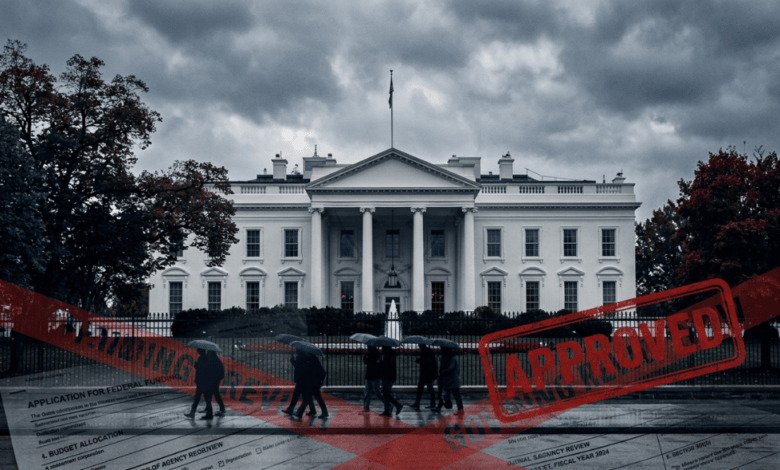
Table of Contents
A Trillion-Dollar Funding Stream Under New Scrutiny
A regulatory proposal introduced by the White House Office of Management and Budget in May would fundamentally change how federal grant money reaches the ground. Under the draft rule, political appointees — not career agency staff — would need to sign off on grants before cities, states, universities, hospitals and nonprofit organizations could receive them. The stated goal is to confirm that recipients’ work aligns with the administration’s policy agenda.
The scope is enormous. The rule would touch federal funding tied to climate programs, education, public health, housing assistance and infrastructure development — essentially the broad machinery through which Washington sends money to local governments and institutions nationwide.
Grant recipients would also face new content-based restrictions once funding is approved. The draft bars the use of federal dollars for what it calls conduct that undermines American values and it would block funding to organizations engaged in certain forms of advocacy or holding particular institutional affiliations. Researchers, in particular, would face some of the tightest limitations, including restrictions on subject matter, professional conferences they may attend and partnerships with outside institutions, including those overseas.
A Flood of Public Objection
Since the proposal was published, federal regulators have received close to half a million formal comments — an extraordinary volume for a budget rule. A large share of those filings raised concerns rather than support and the range of voices involved is notable: university researchers, artists, city officials, professional engineering societies, members of Congress, housing advocates, state attorneys general and private citizens.
Law enforcement groups were among the more unexpected critics. A coalition representing sheriffs, narcotics investigators and prosecutors warned this month that vague standards embedded in the rule could disrupt public-safety programs that depend on steady federal support.
Local officials say they are already feeling the effects of funding uncertainty under the current administration, even before the new rule takes effect. Lansing, Michigan, Mayor Andy Schor said the proposal would touch nearly every category of federal support his city relies on, from policing to housing. He pointed to recent disruptions in which grants meant to address historic housing discrimination and reduce violence in his community were paused or pulled entirely during Trump’s term. Schor said broader authority to cancel grants over policy disagreements could eventually force him to choose between cutting municipal staff or losing funding for programs residents depend on.
Budget Director Defends the Plan Amid Sharp Questioning
Russell Vought, who directs the Office of Management and Budget, has framed the proposal as a tool for rooting out wasteful or ideologically driven spending, including initiatives he associates with progressive social policy. He argues that the executive branch needs stronger mechanisms to ensure accountability over how taxpayer money is distributed, even though the Constitution assigns spending authority to Congress.
Tensions over that argument surfaced during a Senate hearing this past Thursday. Senator Tina Smith, a Minnesota Democrat, pressed Vought on how the policy would apply to a specific case: federally funded research examining why cancer rates are disproportionately high among Black Americans. Vought responded that decisions on such grants would ultimately rest with political appointees at the National Institutes of Health rather than career scientists, though he said expert input would still be considered. Smith countered that the exchange exposed how injecting political judgment into health research funding could produce arbitrary and unfair outcomes.
Part of a Broader Pattern of Spending Fights
The grant proposal is the latest chapter in a longer-running effort by the administration to reshape federal spending outside the traditional congressional appropriations process. Working alongside Vought, the White House has already moved to shrink the federal workforce and has withheld or canceled billions of dollars in previously approved funding, arguing much of it was duplicative or inconsistent with the president’s priorities.
Those earlier moves have drawn bipartisan criticism in Congress and multiple federal courts have ruled that specific funding freezes exceeded the president’s legal authority. Despite that, the administration has pushed forward and supporters see the new grant rule — expected to take effect in October if finalized — as a way to make similar practices permanent and harder to challenge in court.
Opposition Spans Sectors and Political Lines
Reaction to the roughly 400-page proposal has come from an unusually wide cross-section of American institutions.
In Pennsylvania, a regional United Way network warned that the new requirements could expose service providers — including those delivering food and housing assistance — to financial and legal uncertainty that many lack the staff or budget to manage. The Los Angeles County Department of Arts and Culture cautioned that restrictions on grantees’ political and advocacy activity could discourage free expression at cultural institutions such as museums. The National Sheriffs’ Association said many local agencies simply do not have the administrative capacity to meet the proposed compliance demands and a national civil engineering group said the rule could restrict valuable research partnerships with international counterparts.
The strongest resistance has come from the scientific and medical communities. More than 300 organizations, many representing cancer researchers, specialists in neurodegenerative disease and HIV and pediatric care providers, urged regulators to pause the plan, citing risks to ongoing patient care and research continuity. Under the draft rule, entire categories of research — including work related to diversity and inclusion, or studies on sex and gender that the administration considers inconsistent with a strict biological framework — would be ineligible for federal support.
Sudip Parikh, chief executive of the American Association for the Advancement of Science, described the plan as a substantial escalation beyond earlier funding disputes involving agencies like the NIH and the National Science Foundation, saying it prioritizes political considerations over scientific merit and public health needs.
Lawmakers From Both Parties Push Back
Congressional Democrats have been especially vocal. Representative Rosa DeLauro of Connecticut, the top Democrat on the House Appropriations Committee, argued that the proposal threatens the constitutional principle that spending decisions should flow through elected representatives responding to public needs, not through unilateral executive action. She and eleven fellow Democrats holding senior positions on appropriations panels sent a joint letter this week outlining objections, estimating the rule would affect upward of $1 trillion in annual funding.
Criticism has not been confined to one party. Senator Susan Collins of Maine, the Republican who chairs the Senate Appropriations Committee and is up for reelection next year, warned separately that the changes could disproportionately hurt small and rural communities that rely heavily on federal support.
Not everyone opposes the plan. Daniel West of Heritage Action for America, a conservative advocacy group, said some of the criticism has been overstated and predicted that OMB would not back down, describing the effort as a genuine attempt to improve oversight of taxpayer funds.
States Prepare for a Legal Fight
Some opponents appear to be laying groundwork for litigation. A coalition of governors and attorneys general from roughly two dozen states, including New York, California and Colorado, told the administration this week that the proposed rule would violate the Constitution by encroaching on Congress’s exclusive authority over federal spending. Several of those same states have previously prevailed in court against the administration over unilateral funding cuts and they signaled they are prepared to challenge this rule on similar grounds if it is finalized as written.
With the comment period concluded and the administration signaling no plans to retreat, the fight over control of federal grantmaking is likely to intensify as the rule’s targeted October effective date approaches.
Also Read: House Democrats Split Sharply as Majority Backs Effort to Halt Israel Military Aid