California Universal Healthcare Plan Faces Major Economic and Political Challenges, New Report Finds
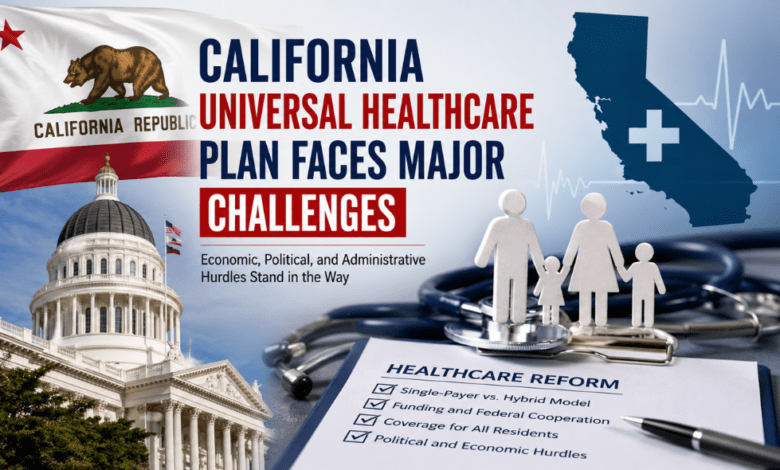
California Universal Healthcare: California’s long-running discussion about creating a universal healthcare system has gained fresh attention following the release of a comprehensive study examining the feasibility of a statewide healthcare financing model. While researchers suggest that a universal system could be achievable, they also warn that numerous economic, political and administrative obstacles would need to be resolved before such a transformation could take place.
The report, prepared by a team of University of California researchers, outlines the complex decisions that policymakers would face if California were to pursue a healthcare system that provides coverage for all residents through a unified financing structure.
Table of Contents
New Study Explores Pathways to Universal Healthcare
The extensive study, spanning more than 180 pages, was commissioned to evaluate the various factors involved in establishing a healthcare system that could consolidate funding from multiple sources into a single framework.
Researchers examined the possibility of combining federal and state healthcare funding with financial contributions that are currently made by employers and individuals. Such a system would aim to provide comprehensive healthcare coverage for California’s residents under a more centralized financing model.
However, the study does not present a single blueprint for implementation. Instead, it identifies a wide range of policy questions and operational challenges that would require careful consideration before any major healthcare restructuring could move forward.
Multiple Models Remain Under Consideration
One of the central findings of the report is that there is no universally accepted model for achieving statewide healthcare coverage.
Policymakers would first need to determine whether California should pursue a traditional single-payer healthcare system, where the government finances most medical services, or adopt a hybrid model that retains certain elements of the existing insurance structure.
Each option carries distinct advantages, costs and political implications, making the decision particularly challenging.
Key Questions Still Require Answers
The report highlights numerous issues that remain unresolved and would significantly influence the design of any future healthcare system.
How Would Healthcare Providers Be Paid?
A major question involves the relationship between the state and healthcare providers.
Officials would need to decide whether California should continue working with existing private and public healthcare providers or develop a new state-controlled network. The method of payment would also need to be determined, including whether services would continue under fee-for-service arrangements or operate through managed care models that currently dominate much of the healthcare market.
What Role Would the Federal Government Play?
Federal healthcare funding represents a substantial portion of healthcare spending in California. Programs such as Medicare, Medi-Cal and healthcare benefits for federal employees account for billions of dollars in annual expenditures.
For a unified healthcare system to function effectively, California would likely require cooperation from the federal government to redirect these funds into a new statewide financing structure.
Securing such approvals could prove to be one of the most complicated aspects of any universal healthcare initiative.
Coverage for Undocumented Residents Remains a Challenge
The report also identifies healthcare access for undocumented immigrants as a significant policy consideration.
Because many federal healthcare programs exclude undocumented individuals from eligibility, state leaders would need to determine how healthcare services for these residents would be financed under a universal system.
The issue carries both financial and political implications and remains one of several critical questions without a clear answer.
Single-Payer System Seen as Efficient but Politically Difficult
Researchers suggest that a true single-payer model could offer substantial administrative efficiencies by reducing paperwork, streamlining billing processes and eliminating many of the complexities associated with the current healthcare system.
Supporters of single-payer healthcare have long argued that a centralized system could lower overall administrative costs while improving access to medical services.
Political Obstacles Could Be Significant
Despite potential efficiency gains, the report notes that a single-payer approach may be the most difficult option to implement politically.
Transforming California’s healthcare system would affect insurers, healthcare providers, employers, taxpayers and millions of residents. Reaching consensus among these stakeholders would likely require extensive negotiations and legislative action.
The political realities surrounding healthcare reform continue to present one of the biggest barriers to large-scale change.
California’s Healthcare Debate Has Been Ongoing for Years
The conversation surrounding universal healthcare is not new in California.
The issue gained renewed prominence during the 2018 gubernatorial campaign when then-candidate Gavin Newsom expressed strong support for a single-payer healthcare system and criticized political leaders who viewed the proposal as unrealistic or financially unattainable.
After taking office, however, Newsom’s approach shifted toward expanding healthcare access through existing programs rather than pursuing an immediate transition to a fully single-payer system.
Instead, his administration focused on incremental healthcare reforms, including broader coverage expansions through Medi-Cal and other state-supported initiatives.
Research and Policy Efforts Continued Under State Leadership
Although California did not move directly toward a single-payer system, state officials continued examining potential pathways to universal healthcare.
In 2019, legislation established a commission tasked with studying healthcare reform options and evaluating ways to improve healthcare access throughout the state.
The commission later recommended exploring a unified financing framework designed to provide broader healthcare coverage while simplifying funding mechanisms.
Senate Bill 770 Advanced the Discussion
The policy discussion gained further momentum with the passage of Senate Bill 770 in 2023.
The legislation called for additional research into healthcare financing alternatives and ultimately led to the University of California study that is now shaping the latest phase of the debate.
The newly released report serves as one of the most detailed examinations yet of what would be required to transition California toward a more comprehensive healthcare system.
What Happens Next?
While the report concludes that a universal healthcare system may be technically achievable, it also makes clear that implementation would require numerous difficult decisions involving funding, governance, provider participation, federal cooperation and public support.
The study does not recommend a final path forward. Instead, it provides policymakers with an extensive roadmap of issues that must be addressed before any major healthcare transformation can occur.
As California’s political leadership evolves in the coming years, questions remain about whether state officials will continue pursuing universal healthcare reforms or whether the latest research will primarily serve as a policy reference for future discussions.
Conclusion – California Universal Healthcare
California’s pursuit of universal healthcare remains one of the most ambitious policy discussions in the United States. The latest University of California report suggests that creating a unified healthcare financing system is possible in theory, but turning that vision into reality would require overcoming substantial economic, political and administrative challenges.
For now, the debate continues, with policymakers facing the difficult task of determining whether the state is prepared to undertake one of the most significant healthcare transformations in its history.
Also Read: Trump Criticizes Netanyahu Over Lebanon Strikes Amid Push for Regional Peace