Ken Paxton Secures Donald Trump’s Endorsement in High-Stakes Texas Senate Showdown
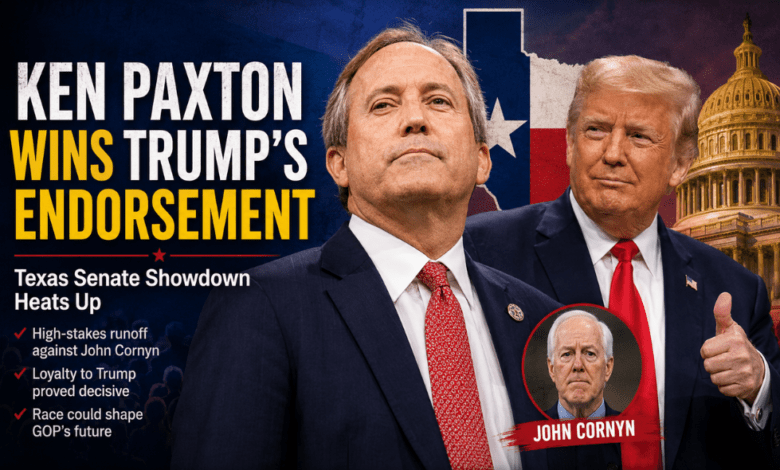
For a while, it looked like Texas Attorney General Ken Paxton was running out of options.
After the Republican primary in Texas, Paxton found himself trailing longtime Senator John Cornyn by a narrow margin. More importantly, many Republicans believed former President Donald Trump was preparing to endorse Cornyn—a move that could have effectively ended Paxton’s campaign.
But instead of stepping aside, Paxton doubled down.
What followed was a tense political battle filled with strategic messaging, behind-the-scenes lobbying and an aggressive push to prove he was the Republican candidate most loyal to Trump. In the end, the gamble paid off.
Trump’s endorsement of Ken Paxton has now completely reshaped the Texas Senate runoff and sent a powerful message about who truly holds influence inside today’s Republican Party.
Table of Contents
A Race That Suddenly Shifted Direction
When the initial primary results came in, Cornyn appeared to have the momentum.
The veteran senator narrowly finished ahead of Paxton, though neither candidate earned enough support to avoid a runoff election. Because of Cornyn’s long history in the Senate and his connections with Republican leadership, many political insiders assumed Trump would eventually back him.
At the time, Trump himself hinted that an endorsement decision was coming soon.
That created serious pressure on Paxton.
There were growing conversations inside Republican circles about whether Paxton should step aside if Trump officially endorsed Cornyn. But Ken Paxton had no intention of leaving the race.
Instead, he searched for a way to regain Trump’s attention.
Ken Paxton’s High-Risk Political Move
In early March, Paxton made a bold public statement supporting the elimination of the Senate filibuster in order to pass the “Save America Act,” a proposal closely tied to Trump’s election security agenda.
The message was aimed directly at Trump and his supporters.
People familiar with the campaign later described it as a political “Hail Mary”—a last attempt to convince Trump that Paxton was the candidate most committed to his vision for the Republican Party.
Paxton reportedly made sure Trump personally saw the statement.
The move may have changed everything.
Trump Delays His Decision
Rather than quickly endorsing Cornyn, Trump suddenly slowed down.
Behind the scenes, several Trump allies were reportedly urging him not to support the Texas senator. They argued that Cornyn had not always stood firmly with Trump and reminded the former president about comments Cornyn made in 2023 suggesting Trump’s political influence was fading.
Those remarks had clearly not been forgotten.
Paxton’s supporters used them repeatedly during the runoff campaign, portraying Cornyn as part of the Republican establishment rather than a true Trump ally.
Loyalty Became the Biggest Issue
The Texas runoff quickly became less about policy differences and more about loyalty to Trump.
For many Republican voters, that issue carried enormous weight.
Paxton’s allies argued that he had consistently defended Trump and aligned himself with the conservative movement, while Cornyn was viewed by some as cautious and too connected to Washington politics.
Texas Congressman Troy Nehls, who backed Ken Paxton early in the race, openly stated that the Republican Party now belongs to Trump and that candidates ignore that reality at their own risk.
That message resonated with many conservative voters across Texas.
Cornyn Tried to Repair the Relationship
Cornyn worked hard to improve his standing with Trump supporters during the campaign.
He emphasized how often he voted alongside Trump’s policies during his presidency and attempted to soften his earlier criticism of the former president. He also introduced legislation that would rename a major Texas highway after Trump.
Still, skepticism among Trump loyalists remained strong.
For many voters, Cornyn’s efforts appeared too late.
Trump’s Influence Over the GOP Keeps Growing
The endorsement also reflected Trump’s growing confidence in reshaping Republican politics.
In recent months, several Republican politicians who criticized or distanced themselves from Trump have faced serious political setbacks. Trump-backed candidates have continued to gain strength in primaries across the country.
That trend appeared to influence the Texas race as well.
Recent Republican Losses Sent a Warning
One important moment came after Louisiana Senator Bill Cassidy suffered a crushing defeat in his reelection effort against Trump-backed challengers.
The result reinforced the idea that Republican candidates who fail to maintain Trump’s support can struggle badly with conservative voters.
Paxton’s campaign quickly pointed to Cassidy’s loss as proof that the Republican base still strongly supports Trump’s leadership.
The message helped build momentum for Ken Paxton just as early voting in Texas began.
The Endorsement Finally Arrives
After weeks of uncertainty, Trump personally called Ken Paxton to tell him he would endorse him in the runoff.
Soon after, the former president publicly announced his support.
The political impact was immediate.
Trump’s endorsement instantly made Paxton the clear front-runner in the race and dealt a major blow to Cornyn’s campaign at a critical moment.
Why the Endorsement Matters So Much
In modern Republican politics, Trump’s backing can completely change the direction of a race.
His endorsements often energize grassroots voters, attract donors, dominate media coverage and influence undecided Republicans. In conservative states like Texas, that influence is especially powerful.
For Paxton, the endorsement validated his strategy of tying himself closely to Trump and his political movement.
For Cornyn, it became another example of how difficult it has become for establishment Republicans to compete against candidates with Trump’s full support.
Democrats Believe the Race Has Changed
While Republicans celebrated the endorsement, Democrats immediately saw an opportunity.
Some Democratic leaders believe Paxton’s legal controversies and combative political style could make him vulnerable in a statewide general election.
Senate Minority Leader Chuck Schumer suggested Democrats now have a stronger chance of competing in Texas if Paxton becomes the Republican nominee.
Even so, Republicans remain confident about holding the seat in a state that has favored GOP candidates for decades.
Questions About Electability Continue
Despite Paxton’s growing support among conservatives, concerns remain inside Republican circles about whether he can win a general election.
Critics argue that his controversies could alienate moderate voters and create openings for Democrats.
Supporters disagree.
They believe Republican voters care more about loyalty, conservative values and fighting the political establishment than traditional concerns about electability.
A Bigger Battle Inside the Republican Party
The Texas Senate runoff has evolved into something larger than a contest between two politicians.
It now reflects a deeper struggle over the future of the Republican Party itself.
On one side are establishment Republicans like Cornyn, who built influence through years of Senate leadership and traditional party politics. On the other side are Trump-aligned conservatives like Paxton, who thrive on direct loyalty to the former president and confrontation with the political system.
Trump’s endorsement made it clear which side currently holds the advantage.
As Texas voters prepare for the runoff election, the race is being watched closely across the country—not only because of its impact on the Senate but because it offers another glimpse into the future direction of the Republican Party in America.
Also Read: Trump-Backed Challengers Oust Senator Bill Cassidy in Louisiana Primary