Tensions Flare as Federal Probe Targets California’s Slow Vote Count
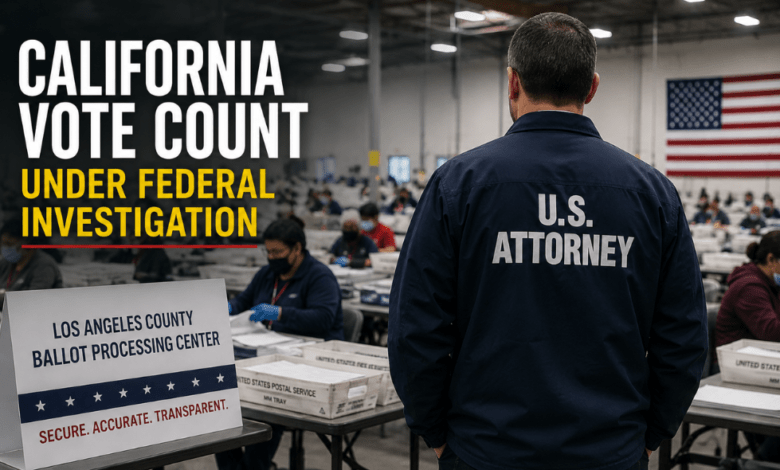
LOS ANGELES — Inside the cavernous, fluorescent-lit rooms of the Los Angeles County ballot processing center, the sound is usually rhythmic: the hum of high-speed scanners, the rustle of paper envelopes and the quiet murmur of election workers meticulously verifying signatures. But on Friday morning, that routine bureaucratic hum collided head-on with national political theater.
In a move that has sharply escalated the political temperature across the state, the U.S. Attorney’s office in Los Angeles announced it has launched multiple election fraud investigations. The escalation became visual when a federal prosecutor was dispatched directly to the county’s central vote-tabulation facility, stepping right into the crosshairs of a fiercely contested primary election.
The intervention did not happen in a vacuum. It follows days of tightening margins in high-stakes races—including the contests for California Governor and Los Angeles Mayor—as a massive wave of late-arriving mail ballots began doing what they historically do: chipping away at early Republican leads.
Table of Contents
A Walkthrough Under Scrutiny
The directives came from U.S. Attorney Bill Rotchford, the top federal prosecutor for the region. On Friday morning, an assistant U.S. attorney walked through the doors of the Los Angeles ballot center, turning what is usually a local administrative task into a focal point of federal scrutiny.
Local election officials, however, tried to keep the temperature low. Mike Sanchez, a spokesperson for the Los Angeles County Registrar-Recorder, described a calm, professional interaction. The prosecutor wasn’t there seizing boxes or demanding halts; instead, they were given a standard walkthrough of the county’s public observation program.
According to Sanchez, the department routinely hosts observers from all walks of life and all political persuasions. In a system built on transparency, a federal attorney is simply another set of eyes.
A Familiar Pattern of Oversight
For local poll workers, federal eyes are nothing new. Just last autumn, the Justice Department sent field observers to monitor polling sites across five California counties—including Los Angeles—during a specialized election regarding the restructuring of the state’s congressional maps. But against the backdrop of today’s highly polarized environment, the stakes feel entirely different.
The “Blue Shift” Reality – Why the Numbers Move
To understand the tension, you have to understand the human behavior behind the data. The shifting numbers that triggered this federal probe are not a glitch in the system; they are a direct reflection of how different Californians choose to vote.
The Psychology of the Ballot
California’s election laws are designed for maximum access. Every single registered voter receives a ballot in the mail and as long as that ballot is postmarked by Election Day, the state gives it seven days to arrive and be counted.
This creates a distinct demographic split in voting habits:
- The Early Wave: Republican-leaning voters in California tend to cast their ballots early or vote in person on Election Day. When the first batches of results are released, conservative candidates often hit their highest percentages of the night.
- The Late Wave: Democratic-leaning voters, by contrast, historically hold onto their mail ballots until the very last minute.
When election workers spend days opening, verifying and scanning those late-arriving envelopes, the totals naturally shift. It is a slow, methodical process that turns election night into election weeks.
The Push for Structural Reform
For critics of the current system, this prolonged waiting period is more than an inconvenience—they argue it erodes public trust.
Republican gubernatorial candidate Steve Hilton is leading the charge for a dramatic overhaul. Hilton is advocating for a system where mail ballots are only sent to citizens who explicitly request them. He also wants to eliminate the seven-day grace period entirely, forcing a hard deadline where every ballot must be physically in the hands of election officials by the time polls close on Election Day.
“Nothing Illegal”
Yet, even as Hilton calls the current system an embarrassment, his critique remains policy-based rather than conspiratorial. In a candid admission, Hilton noted that his own campaign teams have been watching the tabulation process intensely and have found zero signs of foul play.
“We certainly haven’t seen anything of that nature that would warrant legal action,” Hilton stated, acknowledging that while federal prosecutors might claim to have independent leads, the actual counting on the ground looks entirely clean to his team.
The Logistical Wall – Why Speeding Up is Harder Than It Looks
In an effort to soothe public anxiety over the slow count, Hilton floated the idea of sending an “emergency detachment” of state employees to all 58 counties to help local registrars speed up the process.
But on the front lines of election administration, that idea falls flat against practical reality.
The Problem with On-the-Fly Staffing
Jesse Salinas, president of the California Association of Clerks and Election Officers, understands the desire for speed, but warns that good intentions can disrupt delicate operations.
- The Training Burden: You cannot simply hand a stack of sensitive legal documents to an untrained state worker. Anyone touching a ballot or operating counting machinery requires rigorous security training. The very supervisors needed to conduct that training are currently working around the clock to count the votes.
- No More Room: There is a literal space issue. Salinas, who manages the count in Yolo County, pointed out that local ballot processing centers are already packed to maximum capacity. Adding more bodies wouldn’t speed up the count—it would create gridlock.
High Stakes in the Balance
While the legal and political arguments play out in press releases and tweets, the human stakes remain incredibly high for the candidates waiting in limbo.
Hilton himself is locked in a razor-thin, three-way battle against two Democratic rivals to secure a spot on the November ballot. Meanwhile, reality TV personality Spencer Pratt is fighting for political survival against City Councilwoman Nithya Raman for the right to challenge incumbent Mayor Karen Bass this fall.
Until every envelope is sliced open and every signature verified, the workers in Los Angeles will keep doing their jobs—even with a federal prosecutor watching over their shoulders.
Also Read: US House Votes to Limit Trump’s Iran War Powers as Bipartisan Concerns Grow