Supreme Court Ends Limits on Campaign Spending
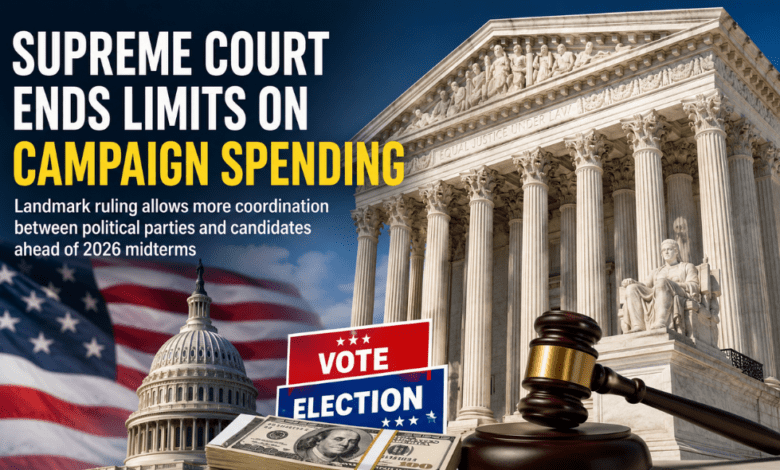
The U.S. Supreme Court has struck down federal restrictions on coordinated spending between political candidates and party committees, a landmark ruling that is expected to reshape campaign financing and election strategy ahead of the 2026 midterm elections.
In a 6-3 decision issued on Tuesday, the court ruled that limits on coordinated expenditures violate constitutional protections for political speech under the First Amendment. The decision grants candidates and national political parties greater freedom to work together on campaign spending, potentially unlocking millions of additional dollars for congressional races across the country.
Table of Contents
Court Finds Spending Restrictions Unconstitutional
The case centered on longstanding federal rules that capped the amount political parties could spend in coordination with individual candidates. These limits varied depending on the size of a state or congressional district and were designed to prevent excessive influence from large donors.
Writing for the majority, Justice Brett Kavanaugh concluded that the restrictions imposed an unconstitutional burden on political expression. He argued that political parties play a critical role in the democratic process and should not be placed at a disadvantage compared with independent political organizations and outside advocacy groups.
According to the ruling, limiting coordination between candidates and their parties weakened traditional party structures while allowing outside groups to exercise growing influence over elections.
Immediate Impact Expected on 2026 Midterm Elections
Election experts expect the decision to have an immediate effect on campaign operations ahead of November’s congressional contests.
With the spending caps removed, candidates will now be able to coordinate with party organizations on a much larger scale. This change effectively increases the amount of money that can be directed toward a candidate’s campaign strategy, advertising efforts and voter outreach programs.
Both major political parties had been preparing for the possibility of such a ruling, recognizing its potential to alter fundraising and spending dynamics during the midterm cycle.
The decision is likely to increase the volume of campaign advertising seen by voters in the coming months, particularly in competitive House and Senate races where financial resources often play a decisive role.
Republicans Celebrate the Decision
Republican leaders welcomed the ruling, describing it as a victory for free speech and political participation.
Former President Donald Trump praised the decision on social media, arguing that it removes barriers to political spending and strengthens First Amendment protections.
The lawsuit challenging the restrictions was originally brought by the National Republican Senatorial Committee (NRSC) in 2022 alongside the Senate campaign of then-Ohio candidate J.D. Vance, who now serves as vice president.
Republican campaign organizations said the ruling would allow them to provide more direct support to candidates and improve their ability to compete in future elections.
Leaders of the NRSC and the National Republican Congressional Committee stated that eliminating the coordinated spending limits restores important political speech rights and enables parties to fully back their nominees during national campaigns.
Democrats Warn of Increased Influence from Wealthy Donors
Democratic leaders responded sharply to the decision, warning that it could increase the influence of wealthy contributors and special-interest groups in federal elections.
Party officials argued that removing the restrictions gives major donors greater opportunities to channel money through party committees, potentially expanding their influence over political agendas and policy priorities.
The ruling comes at a time when Democrats have expressed concerns about fundraising challenges during the current election cycle. Party strategists fear that Republicans, who traditionally attract more large-dollar contributions, may gain an additional advantage under the new rules.
Democratic campaign organizations said the decision could make it easier for affluent donors to exert greater influence over elections and government decision-making.
How the Ruling Changes Campaign Finance
The decision significantly alters the relationship between candidates and party committees.
Under previous federal regulations, coordinated spending was limited even though political parties and candidates often worked closely together. Those restrictions have now been eliminated, allowing party committees to spend unlimited amounts in coordination with campaigns.
The change is particularly important because party organizations can legally accept much larger contributions than individual candidates.
Federal law currently allows national party committees to receive tens of thousands of dollars annually from individual donors, while direct contributions to candidates remain subject to far lower limits. By removing coordinated spending caps, campaigns may gain access to substantially greater financial resources through their party networks.
Potential Shift in Political Advertising Strategies
One of the most significant consequences of the ruling could be its impact on political advertising.
Candidates typically receive discounted rates for television advertisements that are unavailable to outside groups such as super PACs. With expanded coordination between parties and campaigns, political organizations may be able to take greater advantage of those lower advertising costs.
As a result, more campaign funds could be directed toward television advertising, increasing the volume of political messaging reaching voters during the election season.
At the same time, independent groups and super PACs may adjust their strategies by focusing more heavily on digital outreach, direct mail campaigns and other forms of voter engagement that are not affected by television advertising rates.
A Major Shift in the Political Landscape
The Supreme Court’s ruling represents one of the most significant changes to campaign finance regulations in recent years. By eliminating limits on coordinated spending between candidates and political parties, the decision strengthens the role of party organizations while potentially reducing the relative influence of outside groups.
As candidates and party committees adapt to the new rules, the effects are likely to become visible quickly in fundraising efforts, advertising campaigns and overall election strategy. With the 2026 midterm elections approaching, both parties are expected to move rapidly to take advantage of a campaign finance landscape that has been fundamentally reshaped by the court’s decision.
Also Read: Supreme Court Expands Presidential Authority by Overturning FTC Removal Protections