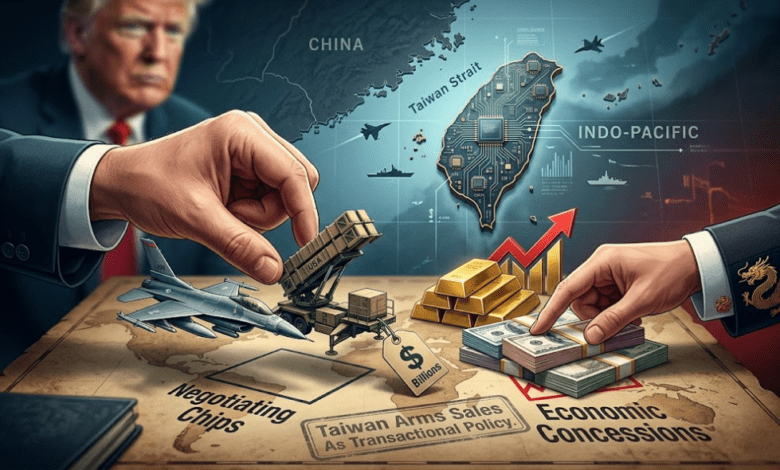
In a dramatic realignment that completely upends decades of bipartisan consensus in Washington, a new geopolitical strategy has emerged that links military deterrence directly to trade leverage. By modifying established diplomatic conventions, the transactional framing of Trump Turns Taiwan Arms Sales into an explicit mechanism for securing economic breakthroughs with Beijing. This sudden restructuring of long-range commitments has sent powerful tremors through regional defense ministries and international diplomatic corridors.
This calculated operational blueprint views the sovereign defense of the self-governed island—a flourishing democratic partner and the foundational core of global advanced microchip fabrication—as a fluid economic asset rather than an unalterable strategic anchor. The paradigm shift where Trump Turns Taiwan Arms Sales into diplomatic leverage fundamentally threatens the precarious balance of power within the contested Indo-Pacific theater. The ramifications cross over into critical electronic manufacturing networks and raise the threat of regional confrontation, compelling allies to re-evaluate their fundamental assumptions regarding American defense guarantees.
Table of Contents
A Transactional Approach to Global Security
Since the enactment of the historic Taiwan Relations Act of 1979, the United States has carefully adhered to a doctrine of strategic ambiguity regarding direct combat intervention. Concurrently, Washington has remained steadfast in delivering advanced defensive capabilities to Taipei, ensuring that the island can effectively discourage cross-strait aggression. This fragile framework has traditionally allowed the United States to expand deep trade ties with the Chinese Communist Party while simultaneously insulating Taiwan’s vibrant democracy from forced integration.
However, during a highly publicized media engagement, this delicate diplomatic arrangement was thoroughly challenged. By explicitly describing a multi-billion-dollar pending military procurement package for the newly inaugurated administration of President Lai Ching-te as a highly valuable negotiating asset, the strategic reality changed. The dynamic wherein Trump Turns Taiwan Arms Sales into an active bargaining instrument suggests an unprecedented openness to hold back or alter critical equipment transfers if Beijing provides major trade concessions to America. This strictly commercial framework strips away the ideological foundations of the alliance, converting sovereign defense mechanisms into ledger components.
The Hardware at the Center of the Debate
The highly specialized weapon systems currently caught in this diplomatic crossfire are engineered specifically for asymmetric defense. These technologies are intended to maximize the friction and cost of any amphibious operation launched across the Taiwan Strait by the People’s Liberation Army.
Asymmetrical Weaponry Systems
The defense framework incorporates highly mobile anti-ship missile units, agile artillery mechanisms, and specialized surveillance drones designed to target maritime forces along the coastline.
Comprehensive F-16 Upgrades
A cornerstone of the pending package involves sophisticated radar modernization and avionics overhauls for Taiwan’s primary tactical fighter squadrons to blunt frequent airspace incursions.
Advanced Air Defense Shielding
The deployment of modernized Patriot missile configurations remains vital for preserving Taipei’s dense metropolitan infrastructure and neutralizing early ballistic threats.
Cyber Warfare Countermeasures
The comprehensive agreement encompasses secure data-link networks and joint training initiatives, designed to safeguard Taiwan’s civilian and defense networks against state-sponsored digital disruption.
As the international community monitors these strategic developments, the realization that Trump Turns Taiwan Arms Sales into an economic asset alters how these military packages are perceived. What once functioned as an unambiguous signal of ideological deterrence is now viewed through the lens of international real estate and transactional commerce.
Beijing’s Perspective and Regional Anxiety
For the leadership in Beijing, which considers Taiwan an inseparable breakaway territory destined for absolute reunification, this rhetoric offers a unique geopolitical opening. While China routinely delivers formal complaints regarding all American defense transactions with Taipei, the structural reality where Trump Turns Taiwan Arms Sales into a commercial asset reinforces Beijing’s narrative that Western defensive guarantees are temporary and transactional rather than permanent.
Conversely, this strategic reorientation has fueled deep apprehension within Taipei and among neighboring partners like Tokyo and Seoul. If the United States treats the immediate security of Taiwan as an exchangeable element for tariff relief, regional powers face the distinct possibility that their own foundational security pacts could be re-evaluated under transactional terms. This shifting baseline threatens the very credibility of extended deterrence across Asia.
Economic Ripple Effects Across the Global South
The geopolitical shockwaves originating from the Taiwan Strait extend far beyond the borders of East Asia, deeply impacting the economic stability of the Global South. Taiwan remains the dominant global producer of advanced semiconductor architectures—the vital microcomponents that run modern communication infrastructure in metropolitan centers like Nairobi and power agricultural optimization tools across the Rift Valley.
Any disruption to Taiwan’s domestic stability threatens the integrity of these supply chains. Concurrently, developing countries navigating complex sovereign debt arrangements and massive infrastructure initiatives with Beijing are monitoring these shifts closely. As the reality that Trump Turns Taiwan Arms Sales into a negotiating tool signals a potential transition away from absolute security guarantees, the resulting geopolitical void will almost certainly expand Chinese influence, redefining choices for nations using major-power competition for local advantage.
Expert Warnings and Historical Precedent
Prominent international relations specialists and national security strategists warn that signaling a willingness to exchange military support for economic outcomes fundamentally weakens the psychological foundation of deterrence. Commenting on the long-term impact of this approach, foreign policy officials have emphasized how dangerous it is to reveal that strategic defense guarantees have an active market price.
“Effective deterrence relies completely on the unshakeable certainty that violating an established border will trigger an immediate and punishing response. When the international community observes that Trump Turns Taiwan Arms Sales into a standard trade asset, the logic of containment fails. It tells aggressive actors that every security red line has a negotiable price, and if they can satisfy that economic requirement, the international rules-based order can be redrawn.” — Strategic Insight Brief, Foreign Policy Consensus
As global capital markets adjust to this calculated transformation of American foreign policy, the overarching stability of the Indo-Pacific remains highly fluid. The tactical environment where Trump Turns Taiwan Arms Sales from a pillar of democratic defense into an active trade chip signals the arrival of a highly transactional era of global statecraft, where historical alliances are balanced directly against immediate economic returns.
Also Read: Denise Powell Wins Omaha Primary – The Fight to Save Nebraska’s “Blue Dot”