Jerome Powell Warns Political Pressure on Fed Could Damage Public Trust
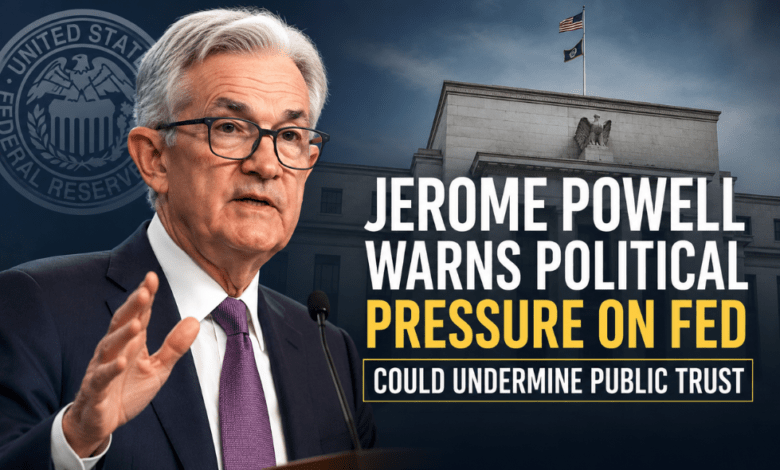
Former Federal Reserve Chair Jerome Powell has issued a strong warning about the growing political pressure facing the U.S. central bank, saying such efforts could ultimately damage public trust in the institution’s independence.
Speaking during an award ceremony at the John F. Kennedy Library Foundation in Boston, Powell reflected on the challenges the Federal Reserve has faced in recent months and cautioned against actions that could blur the line between politics and monetary policymaking.
His remarks came just weeks after his term as Fed chair ended on May 15, though he continues to serve as a governor at the central bank.
Table of Contents
Powell Says the Federal Reserve Is Being Put to the Test
Addressing the audience, Powell described the current environment as a “stress test” for major American institutions, including the Federal Reserve.
According to Powell, organizations that are designed to operate independently are facing increasing political scrutiny. He argued that maintaining confidence in these institutions is essential because public trust is built over decades but can be weakened much more quickly.
The former Fed chair suggested that the central bank’s ability to make decisions based on economic conditions rather than political preferences is one of its most important strengths.
Concerns Over Efforts to Influence Fed Officials
Powell expressed concern about attempts to pressure or remove Federal Reserve officials over disagreements related to policy decisions.
He warned that if one administration succeeds in removing central bank leaders because of differences over monetary policy, future administrations may be encouraged to do the same.
According to Powell, such a precedent could cause Americans to question whether decisions are being made in the country’s best economic interests or for political reasons.
Why Federal Reserve Independence Matters
The Federal Reserve plays a critical role in shaping the U.S. economy through decisions on interest rates and other monetary policies. Those decisions can influence borrowing costs, inflation, employment and overall economic growth.
Because of that responsibility, central bank officials are expected to make decisions based on economic data and long-term financial stability rather than political considerations.
Powell argued that public confidence depends on the belief that the Fed can make those decisions independently.
A Long-Standing Principle of Central Banking
For decades, many economists have viewed central bank independence as an important safeguard against short-term political pressures.
While elected leaders may favor policies that support immediate economic growth, central banks are often tasked with making difficult decisions that may not always be politically popular but are intended to support long-term stability.
Powell’s comments reflected concerns that increased political involvement could make that balance harder to maintain.
Powell References Investigation Into Fed Headquarters Renovation
During his remarks, Powell also pointed to a federal investigation into the Federal Reserve’s Washington headquarters renovation project, which carried an estimated price tag of $2.5 billion.
Federal prosecutors launched the investigation earlier this year but it was later dropped in April.
Powell previously suggested that the probe was linked to frustration over the Federal Reserve’s approach to interest rate policy and its refusal to reduce rates as aggressively as some political leaders wanted.
Lisa Cook Case Also Highlighted
The former chair additionally referenced attempts to remove Federal Reserve Governor Lisa Cook.
Powell cited the situation as another example of the pressure facing officials within the central bank and argued that such actions could raise broader questions about the institution’s ability to operate independently.
Warning About the Strength of Democratic Institutions
Beyond the Federal Reserve itself, Powell used his speech to make a broader point about democratic institutions.
He noted that institutions such as courts, universities and independent agencies require years of effort and public support to build credibility. However, he warned that their foundations can be weakened much more rapidly.
Powell stressed the importance of protecting what works within these institutions while continuing to pursue reforms and improvements where necessary.
Trust Is Difficult to Rebuild
A central theme of Powell’s remarks was the value of public trust.
He suggested that once confidence in an institution begins to erode, restoring that trust can be a long and difficult process. For that reason, he argued that preserving institutional credibility should remain a priority regardless of political differences.
New Leadership Takes Over at the Fed
Powell’s comments come during a transition period at the Federal Reserve.
Kevin Warsh was sworn in as the new chair on May 22, taking over leadership of the central bank at a time when debates over interest rates, inflation and the Fed’s role in the economy remain highly visible.
Although Powell is no longer chair, his continued role as a Fed governor ensures that he remains part of the institution’s policymaking process.
The Debate Over Independence Is Far From Over
Powell’s warning highlights an issue that extends beyond any single administration or policy dispute. At the heart of the discussion is a fundamental question about how independent institutions should operate and how much political influence they should face.
As economic challenges continue to evolve, the relationship between elected officials and the Federal Reserve is likely to remain closely watched. For Powell, the stakes go beyond monetary policy alone—they involve maintaining public confidence in an institution that plays a central role in the nation’s economic future.
Also Read: Jerome Powell Warns Against Political Pressure on Fed and Democratic Institutions During JFK