The Human Cost of Diplomacy – Inside the Trump-Xi Taiwan Summit
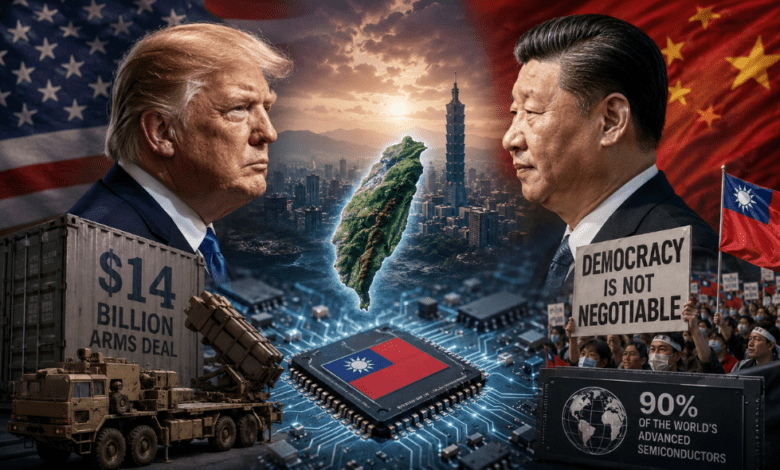
When Air Force One touches down in Beijing this week, the cameras will capture the usual spectacle of a high-stakes summit—the red carpets, the formal banquets and the stiff handshakes. On the surface, the world is holding its breath over global trade and energy bottlenecks in the Middle East. But behind closed doors, President Xi Jinping has a much more personal and singular focus: the future of Taiwan.
For the leaders of the world’s two largest powers, this isn’t just about policy; it’s about a tiny island democracy that has become the ultimate test of nerves, loyalty and the global economy.
Table of Contents
The $14 Billion Choice Sitting on Trump’s Desk
For decades, the U.S. has played a delicate game called “strategic ambiguity”—essentially keeping everyone guessing about whether they would actually step in if China moved on Taiwan. But money and machinery often speak louder than words.
Currently, a massive $14 billion arms package is sitting on President Trump’s desk, waiting for a signature. This follows an $11 billion deal from last year that left Beijing fuming. In a move that has sent ripples through diplomatic circles, Trump suggested he might discuss the details of this specific package with Xi.
To some, it’s a pragmatic negotiation tactic. To others, it feels like a departure from decades of American promises. In Taipei, the question isn’t just about hardware; it’s about whether they are a partner or a “bargaining chip.”
More Than Just Words: The Battle of “Support” vs. “Oppose”
Diplomacy often sounds like a boring game of semantics but in the Taiwan Strait, a single word can change history. China is pushing hard for the U.S. to change its official stance from “does not support” Taiwanese independence to “opposes” it.
While it sounds like hair-splitting, the shift would be a massive psychological and political victory for Beijing. For the 23 million people living in Taiwan, these linguistic tweaks aren’t academic—they represent the difference between a secure future and an existential threat.
The “Silicon Shield” That Protects Us All
It is impossible to talk about Taiwan without talking about the technology in your pocket or the server rooms driving the AI revolution. Taiwan produces roughly 90% of the world’s most advanced semiconductors.
- AI and Defense: The very brains of our modern world are forged on this island.
- Economic Stability: A disruption here wouldn’t just be a local conflict; it would be a global “blackout” for the digital age.
Taiwan’s Deputy Foreign Minister, Chen Ming-chi, remains a steady voice amidst the noise, reminding the world that “The U.S. can count on us as much as we can count on the U.S.”
The Shadow of Hong Kong
President Xi has called the “reunification” of Taiwan an “unstoppable” force of history, often pointing to the “one country, two systems” model used in Hong Kong. But for the Taiwanese people, Hong Kong isn’t a success story—it’s a warning.
The 2019 crackdown on democracy in Hong Kong fundamentally changed the conversation in Taipei. Having lived through their own authoritarian past to build a vibrant, diverse democracy, the Taiwanese public sees their freedom of speech and political identity as non-negotiable. As Chen puts it, the people of Taiwan have never lived a single day under Communist rule—so the idea of “returning” feels less like a reunion and more like an annexation.
A Fragile Peace in a Shifting Timeline
The threat of military action has always loomed large with many eyeing 2027 as a potential breaking point. However, recent reports suggest a slight cooling of the immediate fever. Internal shakeups and purges within China’s military leadership appear to have slowed Beijing’s readiness.
While a March intelligence report suggests an invasion isn’t likely in the next twelve months, the underlying tension remains. The “threat” hasn’t vanished; it’s simply holding its breath.
The Human Element
As Trump and Xi sit down in Beijing, the headlines will focus on the “high-stakes” nature of the summit. But the real story is found in the coffee shops of Taipei and the tech hubs of Hsinchu. It’s the story of a people who have built something extraordinary on a small island and are now watching two giants negotiate over their heads.
Whether the summit results in a new understanding or further friction, one thing is clear: Taiwan is no longer just a “key issue.” It is the center of the modern world.
Also Read: Trump Celebrates Virginia Supreme Court Striking Down Redistricting Map